Point-of-sale statistics 2026

This page includes relevant point-of-sale statistics for 2026, including the most common POS systems, POS industry stats, and how people’s spending habits (such as buy now pay later statistics) are impacting the UK financial market
The way consumers pay for products and services is constantly evolving. Debit cards are now the most common payment method at the point of sale across the UK, accounting for approximately 73% of transactions. This is followed by cash at 56% and credit cards at 41%.
As more people turn to electronic payment methods, businesses are forced to adapt how they accept customer payments. Hence, the evolution of point-of-sale (POS) terminals. But, how does this impact companies, notably small businesses? And what does the future hold for the POS industry?
Our comprehensive point-of-sale statistics report answers questions like these and more, including the most common POS systems for 2026, how the UK mobile POS market is evolving, and the implications for various buy now, pay later (BNPL) statistics.
Top 10 must-know point-of-sale statistics 2026
The global point-of-sale market size is estimated to reach $44.6 billion in 2026. (Fortune Business Insights)
As of December 2025, there were approximately 21.37 million POS terminals across Europe, of which 13.94% were in the UK. (money.co.uk via European Association for Secure Transaction Ltd)
The typical cost of POS hardware can range from £20 to £1,000, depending on its complexity and your requirements. (money.co.uk)
Debit card is the most common payment method at the point of sale, used in 73% of transactions. (Statista)
As of April 2026, the most common POS systems by market share are Square (28.07%) and Toast (23.33%). (6Sense)
In 2025, 43% of UK in-store POS payments were made by debit card. This is expected to drop to 37% by 2030. (World Pay via Statista)
Digital wallets (e.g., Apple Pay) account for 40% of eCommerce payments in the UK. (World Pay via Statista)
The number of mobile POS users worldwide more than doubled from 1.36 billion in 2018 to 3.09 billion in 2025, and is expected to reach 3.81 billion by 2030. (Statista)
By 2030, global POS payments via mobile devices are forecast to reach $25.31 trillion, rising from $18.95 trillion in 2026. (Statista)
The average mobile POS user is expected to spend $5,830 in 2026, increasing to $6,650 in 2030. (Statista)
POS industry statistics
POS system market
The global point-of-sale market was valued at $38.56 billion in 2025. It’s estimated to grow from $44.6 billion in 2026 to $138.92 billion by 2034.
With a compound annual growth rate (CAGR) of 15.3% over the forecast period, the market is projected to grow 211.48% over eight years.
POS software market
The global point-of-sale software market size was $16.37 billion in 2025.
By 2035, it’s forecast to reach $45.34 billion, with a 10.72% CAGR over the forecast period and a total growth of 176.97% over 10 years.
Global POS software market size over time, 2025–35
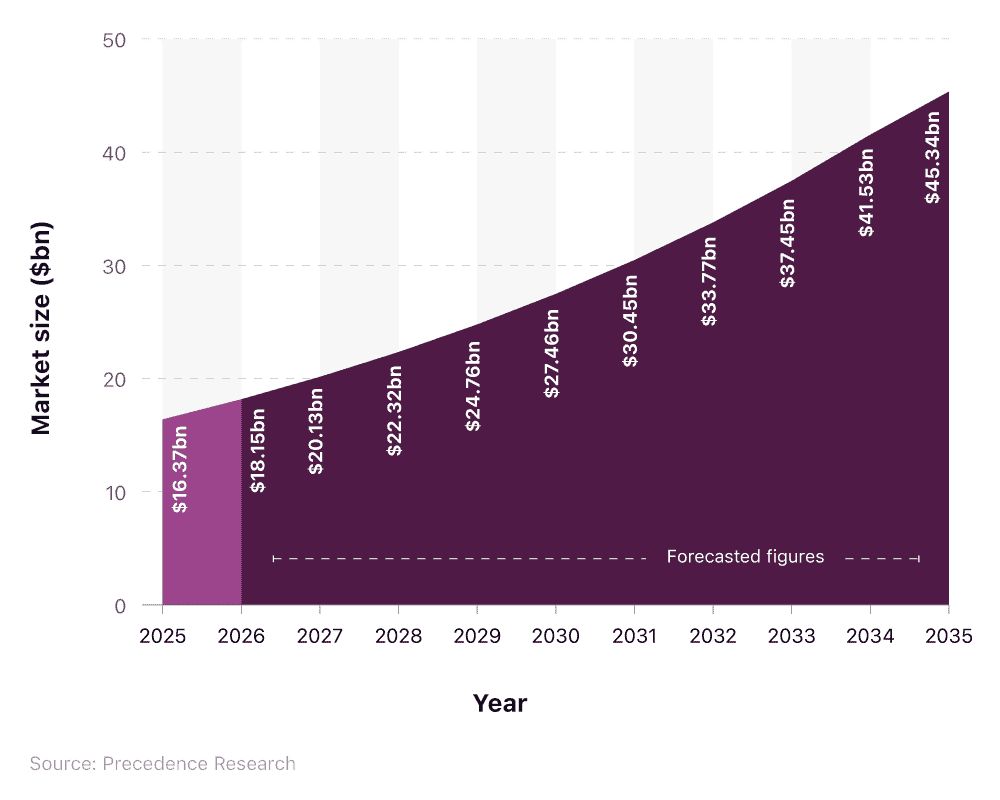
According to findings from Precedence Research:
Asia-Pacific leads the way with a 35% share of the POS software market as of 2025.
The fixed POS segment accounted for 54.90% of application revenue in 2025.
On-premises POS systems accounted for 65.80% of the global POS systems deployment market in 2025.
Large enterprises hold the majority market share, accounting for 57.50% of total revenue in 2025.
The retail segment held the largest share in 2025, at 34.35% across all end users.
POS terminals market
The global POS terminals market was valued at $92.10 billion in 2024. With a CAGR of 9.19% between 2024 and 2030, this is expected to reach $156.08 billion by the end of the decade.
This would result in an expected market growth rate of 69.47% over six years.
The European POS terminal market was estimated at $32.33 billion in 2025. This is expected to more than double to $66.32 billion by 2034, with an 8.31% CAGR over this period.
Number of POS terminals in Europe over time, 2018–25
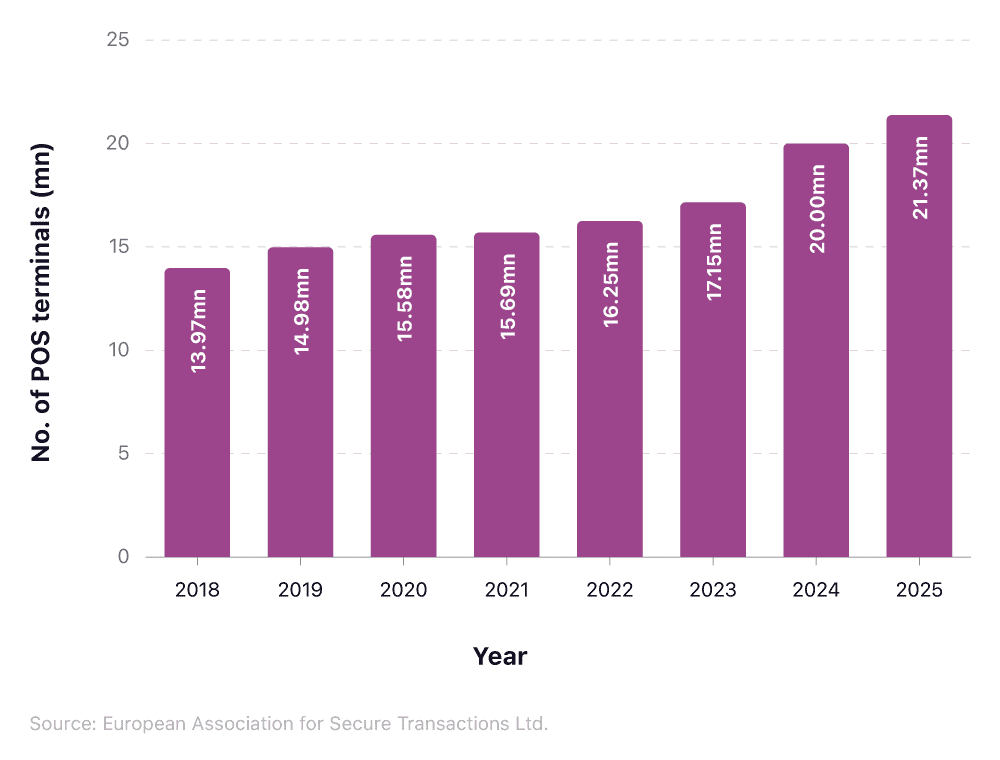
As of 2025, there were approximately 21.37 million POS terminals across Europe. This represented a steady year-on-year (YoY) increase from 2018, when the figure stood at 13.97 million.
This means the number of European POS terminals has increased by about 52.97% over seven years.
Number and percentage of European POS terminals by country, as of 31st December 2025
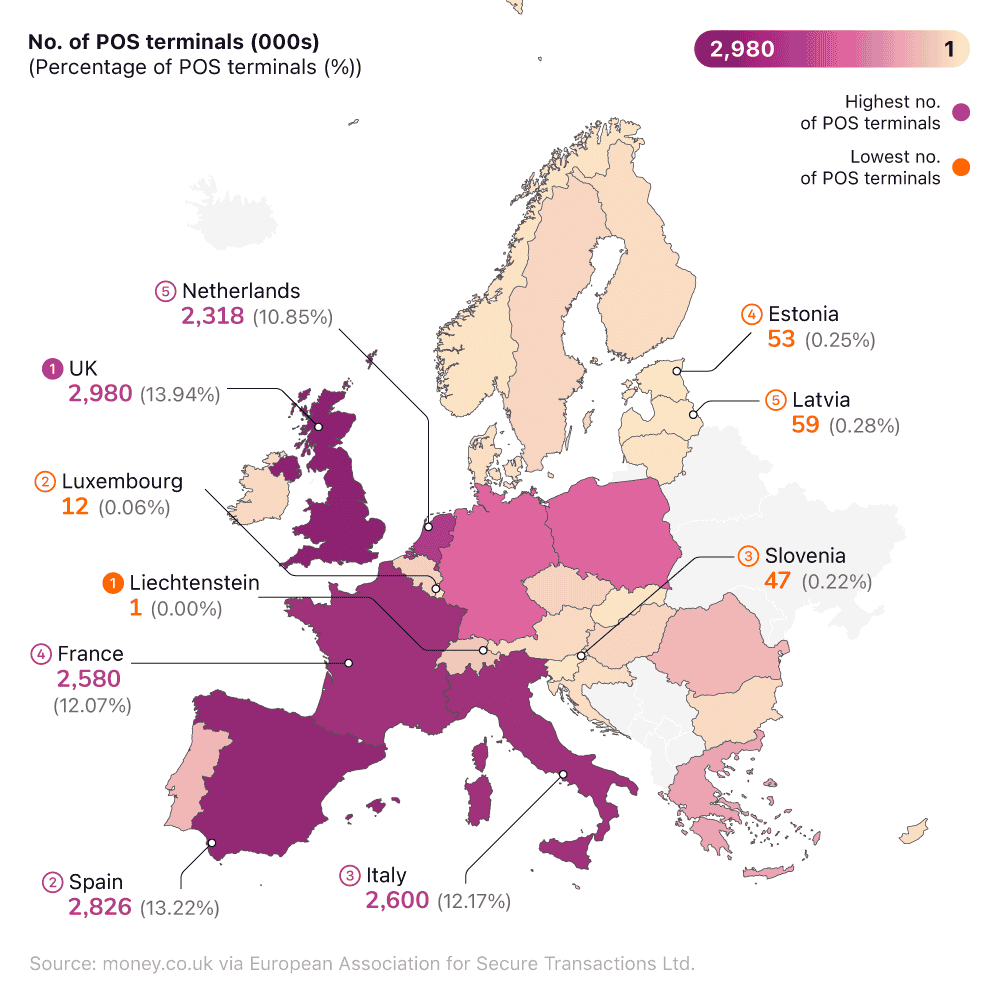
Our analysis shows that the UK had the highest number of POS terminals in Europe in 2025. With approximately 2.98 million, this accounted for around 13.94% of the total. This was followed by Spain (almost 2.83 million) and Italy (2.6 million).
Number and percentage of European POS terminals for selected countries, as of 31st December 2025
| Country | No. of POS terminals (000s) | Percentage of POS terminals (%) |
|---|---|---|
| Poland | 1,392 | 6.51% |
| Germany | 1,344 | 6.29% |
| Greece | 760 | 3.56% |
| Romania | 568 | 2.66% |
| Portugal | 556 | 2.60% |
| Malta | 393 | 1.84% |
| Switzerland | 349 | 1.63% |
| Belgium | 295 | 1.38% |
| Czech Republic | 277 | 1.30% |
| Hungary | 252 | 1.18% |
| Sweden | 239 | 1.12% |
| Ireland | 202 | 0.95% |
| Bulgaria | 196 | 0.92% |
| Austria | 194 | 0.91% |
| Finland | 160 | 0.75% |
| Croatia | 155 | 0.73% |
| Cyprus | 151 | 0.71% |
| Denmark | 138 | 0.65% |
| Norway | 98 | 0.46% |
| Lithuania | 92 | 0.43% |
| Slovakia | 85 | 0.40% |
Source: Data from money.co.uk via European Association for Secure Transactions Ltd.’s POS Terminal Numbers in Europe report
The majority of POS terminals are in Western Europe, with 0.75% in Slovenia, Estonia, and Latvia.
The fewest European POS terminals in 2025 were in Liechtenstein (1,000), followed by Luxembourg (12,000).
Average cost of a POS system
The average cost of a POS system varies depending on what you need—hardware, software, and payment processing—as well as any monthly and transaction fees.
Hardware: A simple card reader should cost between £20 and £50, whereas a full POS terminal typically costs £300–£1,000. Add-ons (such as a barcode scanner or a secure cash drawer) could cost at least £75.
Software: Entry-level packages start at around £30. Some providers include this in their fees, charging higher processing fees to recoup the fact there’s no up front costs.
Monthly fee: Small businesses can expect to pay between £25 and £70 per month for a package that includes software but not hardware. New customers may not face a monthly fee, but this can vary by provider.
Transaction fee: Typically sits between 1.5% and 2.5% of the total cost per transaction. Online purchases may also come with an additional flat charge.
For more information, check out our guide on the cheapest way to accept card payments in the UK.
Most common POS systems
As of 2025, the most common payment method at the point of sale across the UK was debit cards. This was used by 73% of consumers surveyed by Statista.
Most common payment types at the point of sale in the UK, 2025
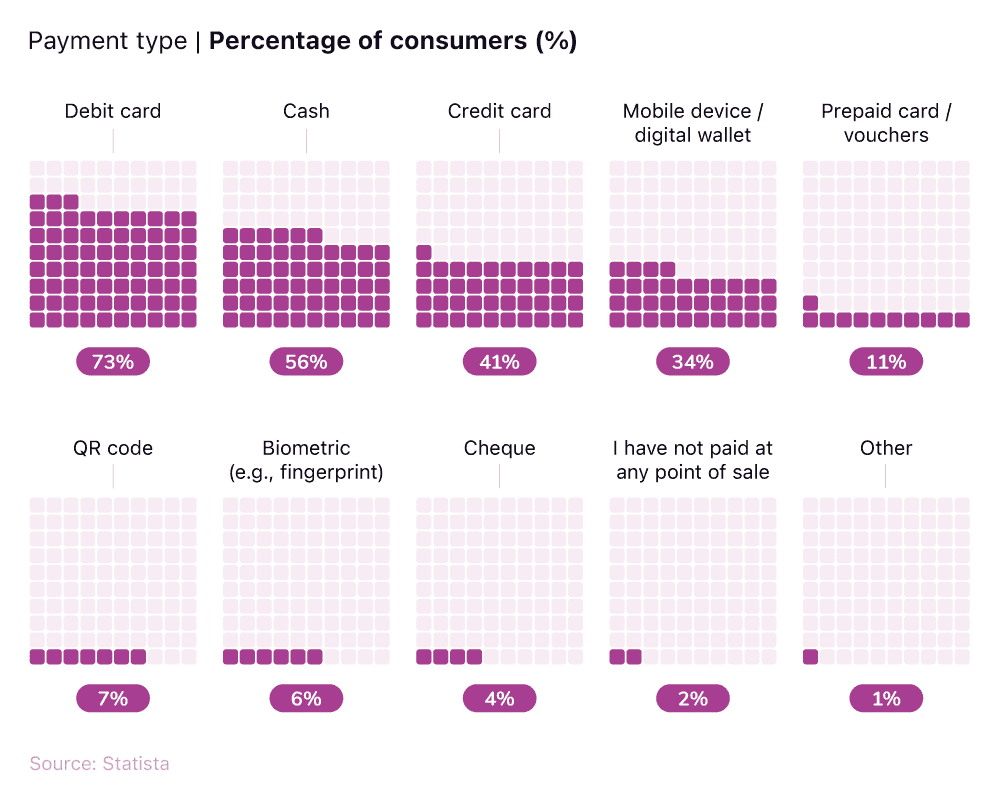
This was followed by cash (56%) and credit cards (41%) as the next most-used payment methods at the point of sale.
Accepting credit card payments is therefore still an important consideration for businesses, as credit cards were used by around two in five consumers in 2025. However, as more than half of people still use cash to make purchases, companies cannot totally disregard the importance of accepting money over the counter.
For further reading, check out our guide on whether your business should go cashless: the pros, cons, and potential costs for your organisation.
Market share of in-store POS payment methods in the UK over time, 2017–25 and 2030 forecasts
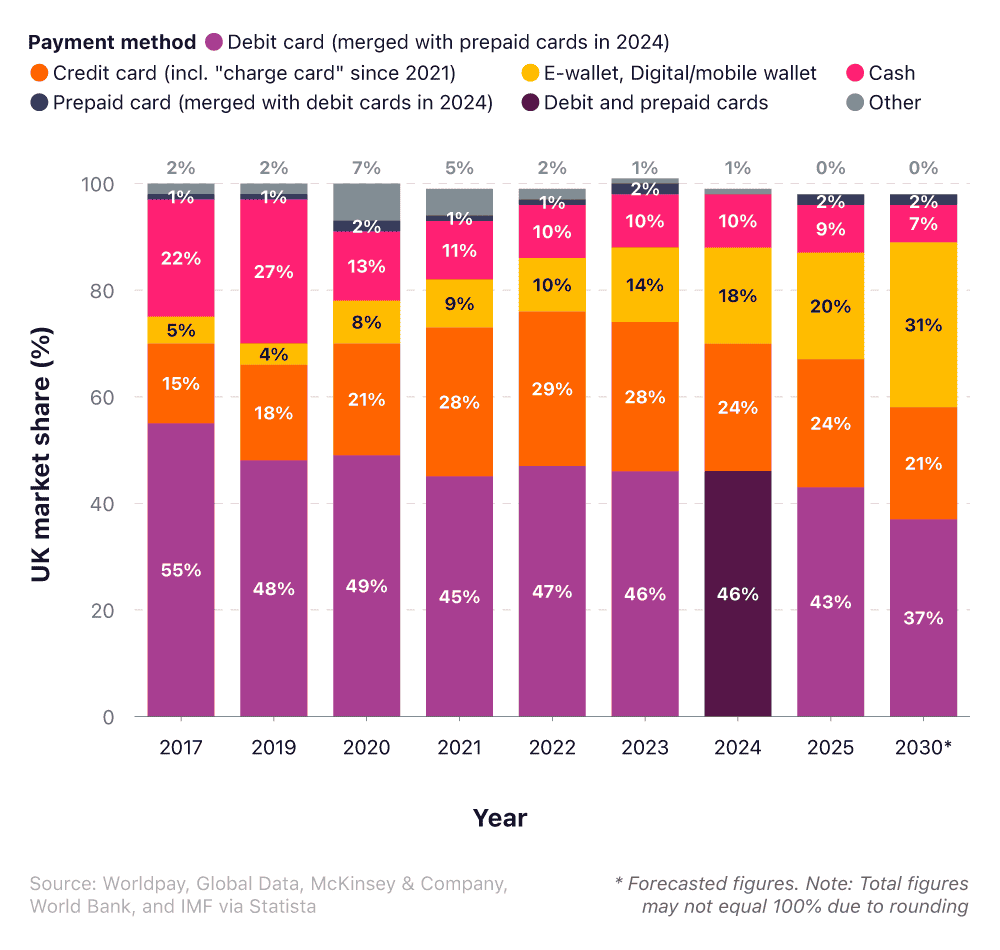
Debit cards held the largest market share of UK in-store POS payments in 2025, at 43%. This was almost the same as the combined total for credit cards and e-wallet payments (24% and 20%, respectively).
Since 2017, the market share of in-store POS payments made with debit cards has gradually decreased, from 55% to 43%. By 2030, this figure is expected to reach a low of 37%.
A similar trend is expected for in-store cash use, with a decrease of around two-thirds between 2017 and 2030, from 22% to 7%.
Conversely, the proportion of consumers using e-wallet payments is expected to increase sixfold over this period, rising from 5% in 2017 to 31% by 2030.
Most common eCommerce payment types in the UK, 2025
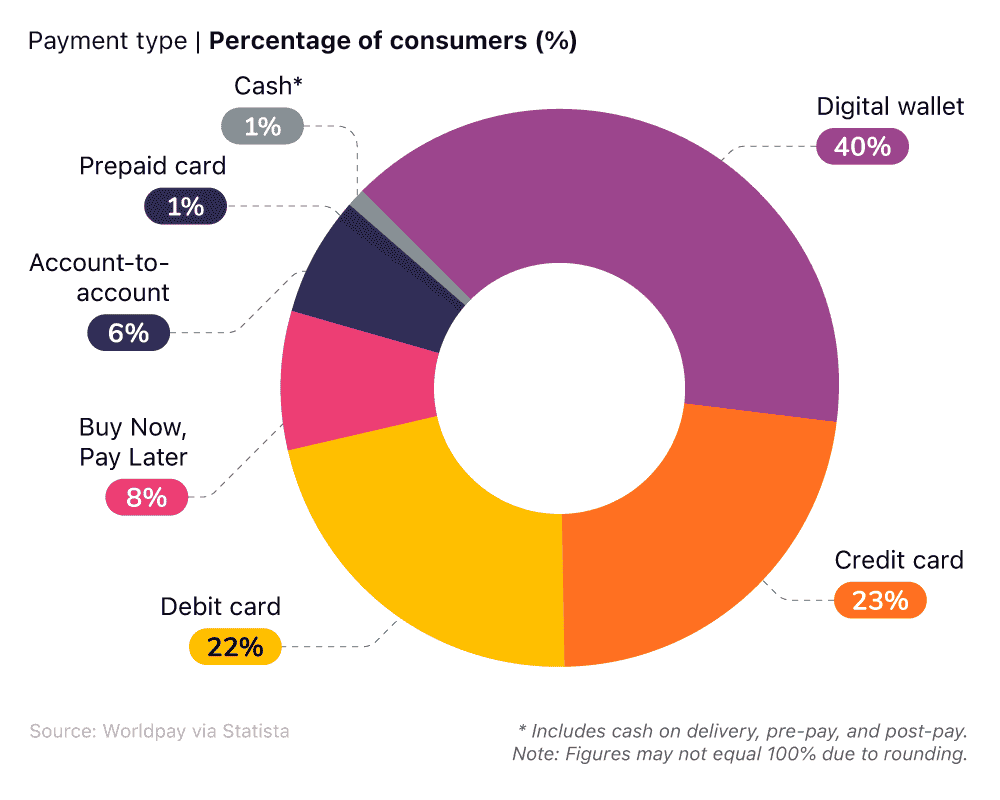
Digital wallets such as Apple Pay and Google Pay were the most common eCommerce payment methods in the UK in 2025, accounting for 40% of transactions.
This was followed by credit cards (23%) and debit cards (22%).
“Debit card use at the till is gradually declining while digital wallets keep gaining ground. For small businesses, that makes accepting wallet payments like Apple Pay and Google Pay increasingly important.”

Top 10 most common POS systems by market share, 2026
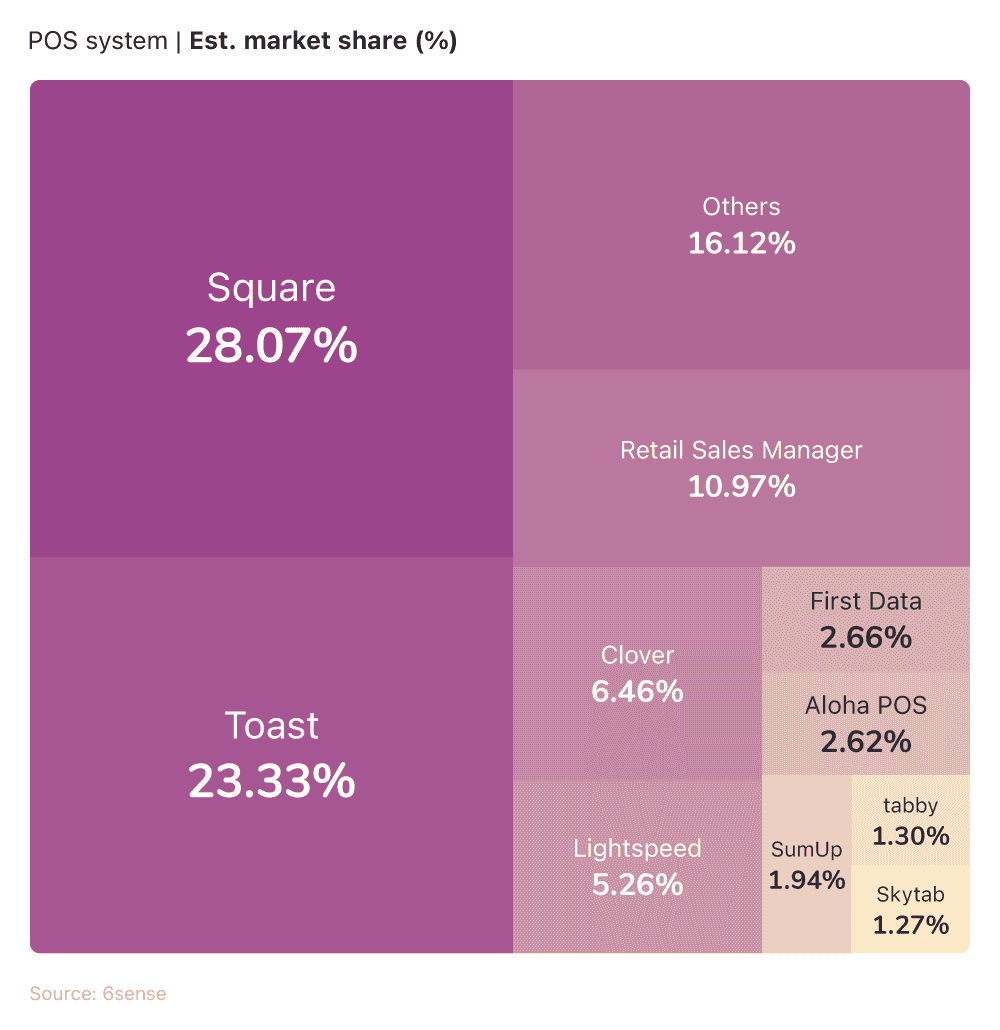
Note: Data accurate as of 30 April 2026. The data source for this graphic (6Sense) uses a moving tracker; therefore, the numbers are subject to change over time.
As of 2026, Square was the most widely used POS system worldwide, with a 28.07% market share. This was followed by Toast (23.33%) and Retail Sales Manager (10.97%).
Most common POS systems by search interest over time, 2004–26
| Year | Square | Shopify | Toast | Clover | Lightspeed |
|---|---|---|---|---|---|
| 2011 | 2 | 0 | 0 | 0 | 3 |
| 2012 | 4 | 0 | 0 | 0 | 3 |
| 2013 | 6 | 1 | 0 | 0 | 3 |
| 2014 | 7 | 4 | 1 | 5 | 3 |
| 2015 | 8 | 5 | 1 | 8 | 5 |
| 2016 | 10 | 6 | 3 | 8 | 4 |
| 2017 | 16 | 7 | 5 | 9 | 4 |
| 2018 | 17 | 9 | 7 | 9 | 4 |
| 2019 | 19 | 9 | 10 | 10 | 7 |
| 2020 | 16 | 11 | 10 | 8 | 13 |
| 2021 | 16 | 10 | 10 | 9 | 17 |
| 2022 | 20 | 13 | 12 | 10 | 8 |
| 2023 | 22 | 17 | 15 | 11 | 7 |
| 2024 | 25 | 21 | 15 | 11 | 6 |
| 2025 | 42 | 35 | 29 | 17 | 10 |
| 2026* | 77 | 48 | 38 | 29 | 16 |
Source: money.co.uk via Google Trends
* The average figure for 2026 is only for January to May.
Note: The Google Trends index score is a relative measure of popularity, not an absolute one. It indicates how popular search terms are, relative to one another (with an index score out of 100), rather than a measure of average monthly search volumes. The closer the number is to 100, the more “popular” that word is.
Square was the most commonly searched POS system in 2026, with a Google Trends index score of 77. This was around 60% more popular, relatively speaking, than Shopify in second and more than twice as popular as relative searches for Toast.
The relative popularity of the most-searched POS systems has steadily increased, with Square dominating the top spot since 2012. Since then, its search popularity has been almost 20 times higher in 2026 than in 2012, with index scores of 77 and four, respectively.
A similar trend occurred for:
Shopify, rising from an index score of 0 between 2004 and 2012, up to 48 in 2026.
Toast, increasing from an index score of one in 2014, up to 38 in 2026.
Clover, rising from an index score of 5 in 2014, up to 29 in 2026.
Biggest contactless payment brands in the UK, 2024, and the US, 2025, at the point of sale
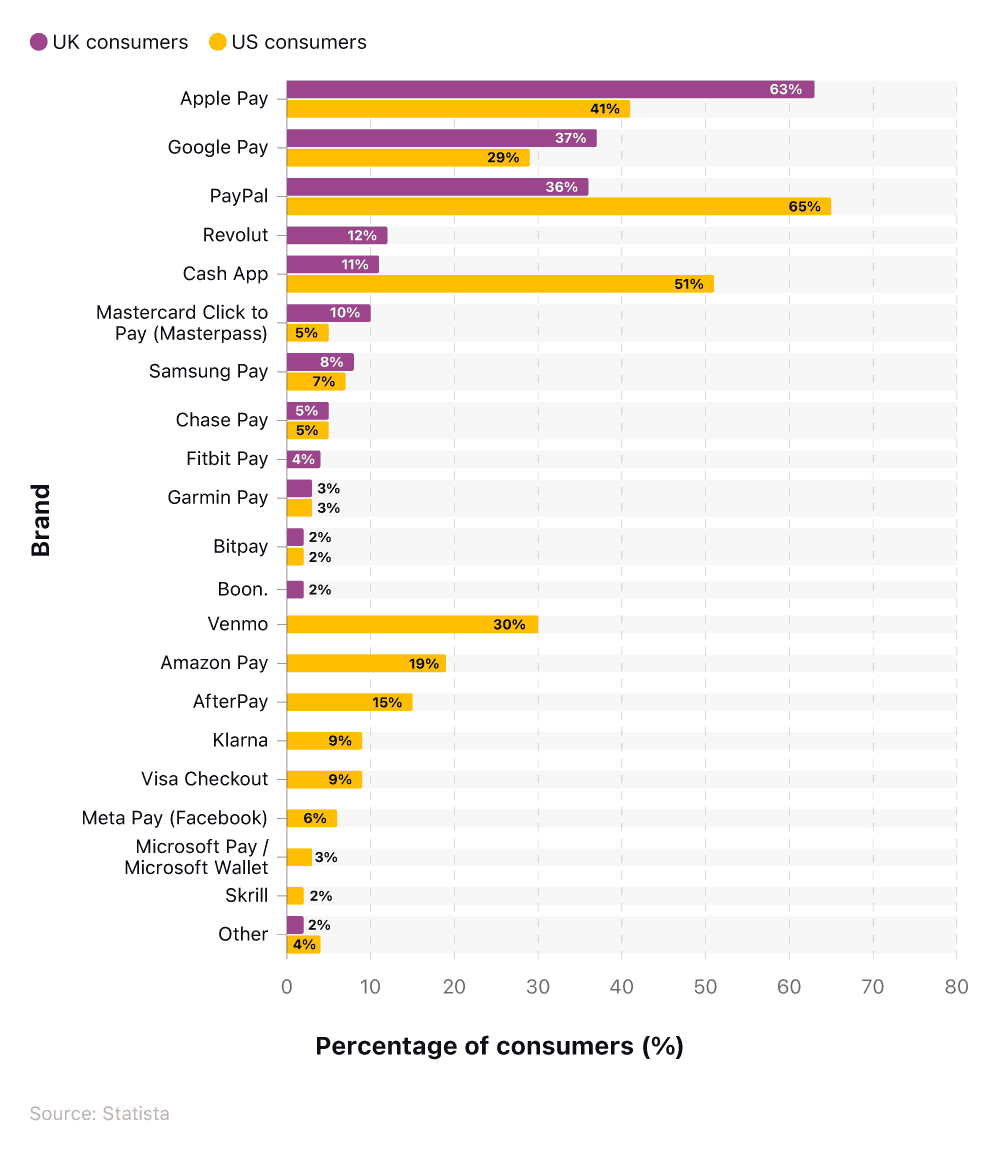
Point-of-sale market research from Statista shows that Apple Pay was the most common contactless payment brand in the UK in 2024, used by 63% of consumers. This was followed by 37% who used Google Pay and 36% for PayPal.
By contrast, PayPal was the most common contactless payment brand in the US in 2025, at 65%, followed by Cash App (51%) and Apple Pay (41%).
Findings from these consumer surveys highlight some differences in contactless spending habits between UK and US consumers. For example:
Cash App was the second-most-popular contactless brand in the US in 2025 (51%), yet it was used by only 11% of UK consumers in 2024.
Revolut was used by 12% of UK consumers for contactless transactions in 2024, but didn’t even feature on the list for US consumers in 2025.
Eight contactless brands were used by US consumers in 2025, ranging from Venmo (30%) to Skrill (2%). But none of these was used by anyone surveyed in the UK in 2024.
POS market performance statistics
In 2025, Block, Inc. reported a gross profit of $10.369 billion. The majority (around 61%) of this came from Cash App, with almost 38% from Square.
Gross profit of Block, Inc. by source over time, 2021–25
| Year | Square (billion) | Cash App (billion) | Corporate and other (billion) |
|---|---|---|---|
| 2021 | $2.32bn | $2.07bn | $0.032bn |
| 2022 | $2.71bn | $3.25bn | $0.040bn |
| 2023 | $3.13bn | $4.32bn | $0.053bn |
| 2024 | $3.60bn | $5.24bn | $0.051bn |
| 2025 | $3.94bn | $6.34bn | $0.089bn |
Source: Block, Inc.’s Block Investor Presentation Q4 2025
Block, Inc.’s gross profit has risen year-on-year (YoY) since 2021, when it stood at $4.422 billion. This means the company's gross profit more than doubled in just four years (134.49%).
Revenue and gross profit statistics for Toast, Inc. by source over time, 2024 vs 2025
| Source | 2024 (million) | 2025 (million) | |
|---|---|---|---|
| Revenue | Subscription services | $706mn | $936mn |
| Financial technology solutions | $4,053mn | $5,037mn | |
| Hardware and professional services | $201mn | $180mn | |
| Costs of revenue | Subscription services | $219mn | $264mn |
| Financial technology solutions | $3,175mn | $3,891mn | |
| Hardware and professional services | $371mn | $400mn | |
| Amortisation of acquired intangible assets | $5mn | $5mn | |
| Gross profit | $1,190mn | $1,593mn |
Source: Toast, Inc.’s Fourth Quarter and Full Year 2025 Financial Results report
Toast, Inc. recorded a gross profit of $1,593 million in 2025. This represented an increase of 33.87% compared to 2024.
The majority of Toast, Inc.’s revenue in 2025 stemmed from financial technology solutions ($5,037 million). However, this was somewhat offset by $3,891 million in costs in this category, resulting in a gross profit of $1,146 million for financial technology solutions.
Revenue and gross profit statistics for Fiserv, Inc. by source over time, 2024 vs 2025
| Source | 2024 (million) | 2025 (million) | |
|---|---|---|---|
| Revenue | Processing and services | $16,637mn | $16,879mn |
| Product | $3,819mn | $4,314mn | |
| Total | $20,465mn | $21,193mn | |
| Costs of revenue | Processing and services | $5,363mn | $5,802mn |
| Product | $2,650mn | $2,810mn | |
| Selling (general and administrative) | $6,564mn | $6,883mn | |
| Net gain on sales and distribution of assets | – | ($120mn) | |
| Total | $14,577mn | $15,375mn | |
| Gross profit | $5,879mn | $5,818mn |
Source: Fiserv, Inc.’s Fourth Quarter and Full Year 2025 Results report
Fiserv, Inc. reported a gross profit of $5,818 million in 2025. This was slightly down on 2024 figures, by around 1.04%.
Revenue actually increased by 3.56% between 2024 and 2025. However, this was offset by a 5.47% increase in revenue costs during the same period.
Business performance indicators for Shopify over time, 2024 vs 2025
| Indicator | 2024 (million) | 2025 (million) |
|---|---|---|
| Gross Merchandise Value (GMV) | $292,275mn | $378,441mn |
| Monthly Recurring Revenue (MRR) | $178mn | $205mn |
| Revenue | $8,880mn | $11,556mn |
| Gross profit | $4,472mn | $5,555mn |
| Operating income | $1,075mn | $1,468mn |
| Free cash flow | $1,597mn | $2,007mn |
Source: Shopify’s Standout 2025: The Launchpad for a New Era of Commerce in 2026 report
Shopify reported gross profit of $5,555 million in 2025, a 24.22% increase from 12 months earlier.
Particular business highlights from 2025 include:
29% GMV growth and three times greater GMV than in 2020.
30% revenue growth and 3.9 times greater revenue than in 2020.
11 consecutive quarters of 25% or more revenue growth (excluding logistics).
A US eCommerce market share of more than 14%.
36% growth in international revenue.
27% growth in offline revenue.
96% growth in B2B GMV.
37% growth in gross payment volume.
62% growth in Shop Pay GMV.
Lightspeed market performance statistics
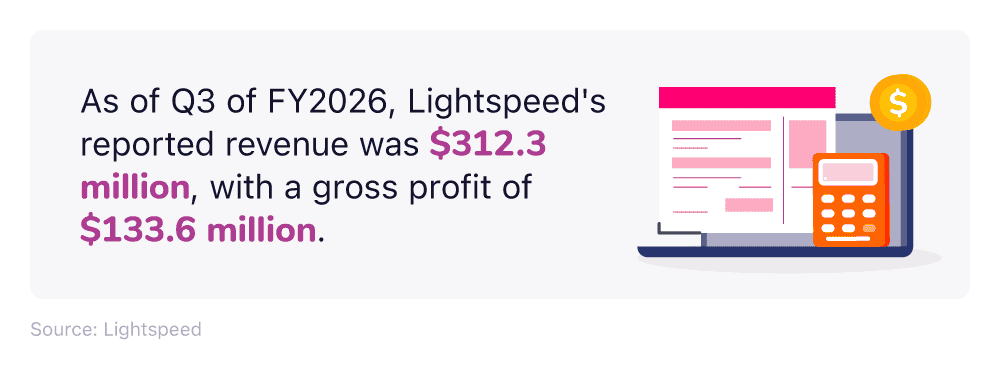
Lightspeed’s reported financial figures, as of Q3 of FY2026, show:
$312.3 million in revenue, with a gross profit of $133.6 million.
$10.5 billion in gross payment volume, representing 19% growth in the three months ending 31 December 2025 vs 31 December 2024.
11% growth in average revenue per user (2025 vs 2024) to an approximate value of $660.
11% growth in revenue in the three months ending 31 December 2025 vs 31 December 2024.
Around 97% in recurring or recurring subscription and transaction-based revenue for the three months ending 31 December 2025.
Gross profit margins improved to 43% with a 15% year-on-year (YoY) increase in gross profits.
Approximately 2,600 net customer locations were added in growth engines for North American retail customers and European hospitality customers (as of 31 December 2025 compared with 30 September 2025).
The total revenue of growth engines grew 21% YoY.
POS and UK SMEs survey statistics
In April 2026, Money.co.uk surveyed 500 UK SME business owners who use a card payment system.
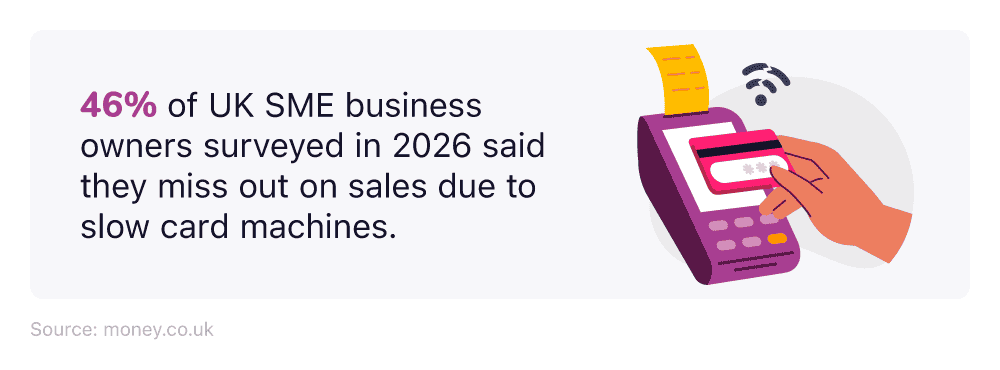
The results found that:
46% said they miss out on sales due to slow card machines. This could be due to cancelled sales at the till or customers heading to the door after waiting in long queues.
Of those who estimate they lose trade, 61% think they miss out on over £2,500 a year, while 31% believe they’re missing out on at least £10,400 a year.
Almost one in 10 (8%) SMEs that estimate lost revenue due to slow card machines believe the issue causes around £20,800 in lost sales annually.
One in four (27%) small businesses has saved or expects to save at least £1,200 a year by switching providers.
One in six (16%) small businesses has saved or expects to save at least £1,800 a year by switching providers.
Mobile point-of-sale statistics
UK mobile POS market
The UK mobile POS market size was estimated at $1.25 billion in 2024 and is projected to grow from approximately $1.36 billion in 2025 to around $3.03 billion by 2035. This represents an 8.3% CAGR over the forecast period and a 122.79% increase over 10 years.
The UK’s broader mobile payments market was valued at $2.13 billion in 2025 and is estimated to reach $2.68 billion in 2026. This indicates an expected 25.82% rise over 12 months.
By 2031, the UK’s mobile payments market is anticipated to reach $8.49 billion, growing at a CAGR of 25.92% between 2025 and 2031. This would represent an overall increase of almost 300% in six years.
What’s the difference between the mobile POS market and the mobile payments market?
The mobile POS market refers to the sector that provides hardware and software for merchants to accept mobile payments, whereas the mobile payments market is the broader, consumer-facing industry that includes all digital transactions made via smartphones, such as digital wallets.
Further analysis shows that, for the UK’s mobile payments market in 2025:
67.32% of payments were made in person (proximity), with remote payments expected to grow at a 30.12% CAGR through 2031.
59.25% of revenue share came from in-store POS systems, while peer-to-peer (P2P) transactions recorded the highest projected CAGR at 28.14% through 2031.
34.32% were in the retail and eCommerce sector, with transportation and logistics anticipated to grow the fastest, at a 31.12% CAGR to 2031.
81.35% were from personal users, with business users advancing at 24.18% CAGR through 2031.
Main factors impacting the UK mobile POS market
| Factor | Approx. percentage impact on CAGR forecast (%) | Geographical relevance | Impact timeline |
|---|---|---|---|
| Development of open-banking-enabled wallet top-ups | 5.30% | UK-wide, urban concentration | Medium term (2–4 years) |
| UK Faster Payment Scheme accelerating PSP adoption | 4.80% | National, metro focus | Short term (2 years or less) |
| Buy-now-pay-later (BNPL)-integrated wallets are increasing the number of basket conversions | 4.10% | National, eCommerce hubs | Short term (2 years or less) |
| Increase in QR-code acceptance across SME merchants | 3.70% | England, Scotland, and Wales | Medium term (2–4 years) |
| Retailer-led supper-app ecosystem | 3.20% | UK-wide | Medium term (2–4 years) |
| Growth in wearable payments on the London transport network | 2.90% | London (followed by other cities later on) | Medium term (2–4 years) |
Source: Mordor Intelligence’s United Kingdom Mobile Payments Market Size & Share Analysis report
Analysis by Mordor Intelligence suggests that the development of open-banking-enabled wallet top-ups could have the greatest impact on the forecasted CAGR for the UK mobile point-of-sale market, at 5.3%. This is expected to impact the UK as a whole, with a particular concentration in urban areas. However, this is expected to have a medium-term impact (between two and four years).
Development of open-banking-enabled wallet top-ups
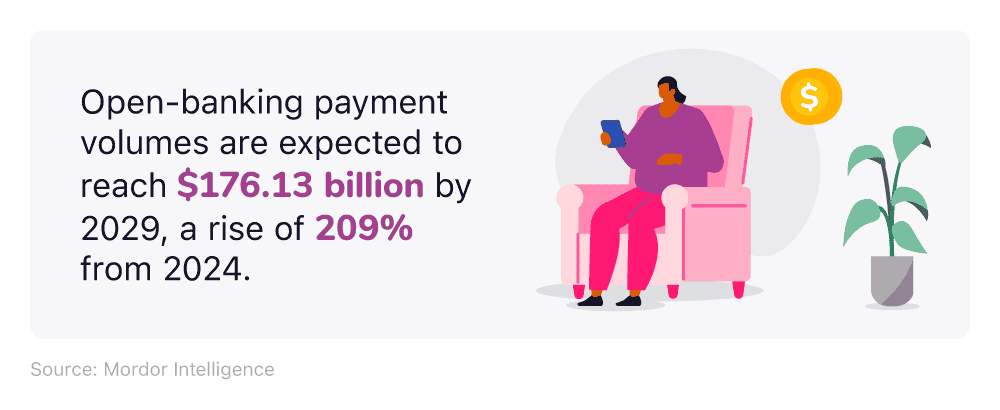
Open-banking payment volumes reached $57 billion in 2024, a figure expected to rise by 209% to $176.13 billion by 2029. This is facilitated by the growing adoption of application programming interface (API) standards and consumer familiarity with “pay-by-bank” buttons.
As of 2024, 13% of customers and 18% of small businesses used an open banking service each month.
Providers expect that, by the end of 2026, multi-bank top-ups will become table-stakes functionality (the minimum expected capability for a product or service to be considered credible and competitive in the market). This should solidify wallet loyalty and place the UK’s mobile payments market as the benchmark for embedded finance.
UK Faster Payment Scheme accelerating PSP adoption
The Faster Payments Scheme exceeded $4.7 trillion (or £3.7 trillion) in account-to-account transfers throughout 2023. This was a 15% increase from 2022.
Instant settlement features make it easier for consumers to split bills, gift money, or settle rent almost instantly. Launched in 2025, Visa’s A2A overlay service adds chargeback-style dispute management and biometric confirmation to the scheme, making P2P transfers safer.
Increase in QR-code acceptance across SME merchants
QR-code scans offer a cost-effective alternative to card payments for small businesses, such as corner shops, market stalls, and mobile traders. Hardware needs are limited to printing a QR code, and the consumer has a camera-equipped mobile phone. This enables merchants to keep processing costs below 0.2%.
Main factors restraining the UK mobile POS market
| Factor | Approx. percentage impact on CAGR forecast (%) | Geographical relevance | Impact timeline |
|---|---|---|---|
| Interchange fee caps reducing PSP margins | -2.10% | UK-wide, particularly small PSPs | Short term (2 years or less) |
| Rising APP fraud losses | -1.90% | Urban areas | Short term (2 years or less) |
| Demographic payments exclusions (especially those aged 55 and above) | -1.60% | Rural areas | Long term (4 years or more) |
| Fragmented wallet loyalty-point interoperability | -1.40% | National, multi-wallet users | Medium terms (2–4 years) |
Source: Mordor Intelligence’s United Kingdom Mobile Payments Market Size & Share Analysis report
Interchange fee caps are reducing PSP margins
Debit and credit interchange fees have remained at 0.2% and 0.3%, respectively, since 2015. This has created a squeeze for small and medium-sized PSPs.
In response, card schemes have raised non-regulated ancillary fees, adding approximately £170 million to the cost of acceptance for UK merchants over seven years.

Rising APP fraud losses
72% of fraud originates online, with the majority stemming from investment scams. Providers have introduced various safety measures, such as biometrics, real-time device fingerprinting, and a network-level scam database. But this comes at an added cost and requires more time to embed these features.
What is APP fraud?
APP fraud is a scam when fraudsters trick people into making large bank transfers to them. This may involve posing as someone from their bank or falsely claiming the person is a victim of fraud and needs to move money into a different account urgently.
Global transaction value of mobile POS payments over time, 2018–30
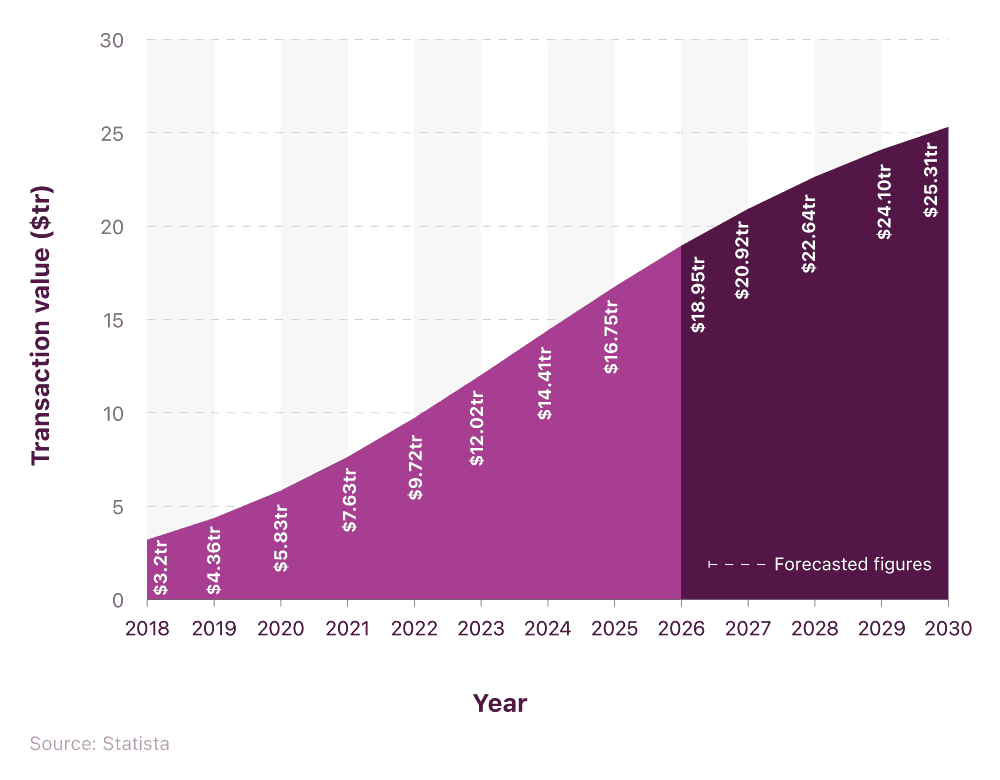
The global transaction value of mobile POS payments stood at $16.75 trillion in 2025. This represents a rise of more than 400% from 2018, when the figure was $3.2 trillion.
By 2030, global POS payments via mobile devices are forecast to reach $25.31 trillion (an increase of 51.1% over five years).
Percentage change in the global transaction value of mobile POS payments over time, 2019–30
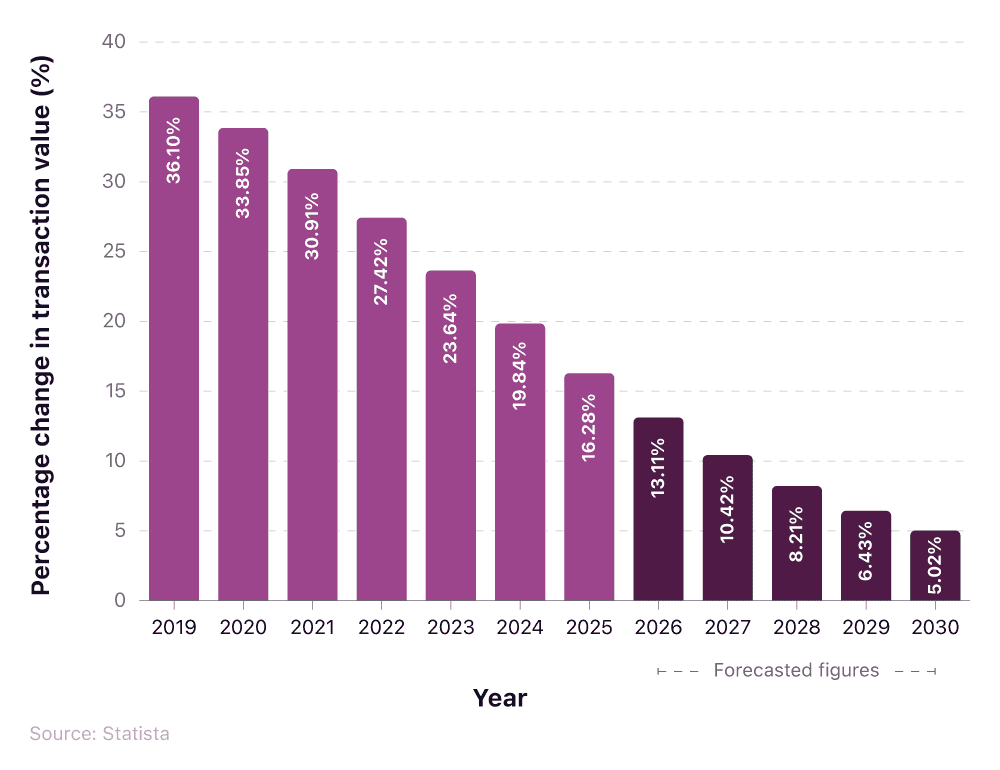
The global transaction value of mobile POS payments grew by 16.28% in 2025. Yet this figure has been decreasing YoY since 2019, when the annual percentage change was 36.1%.
This downward trend is expected to continue in the coming years, gradually falling to 5.02% by 2030.
Top 10 countries for mobile POS transaction value, 2025
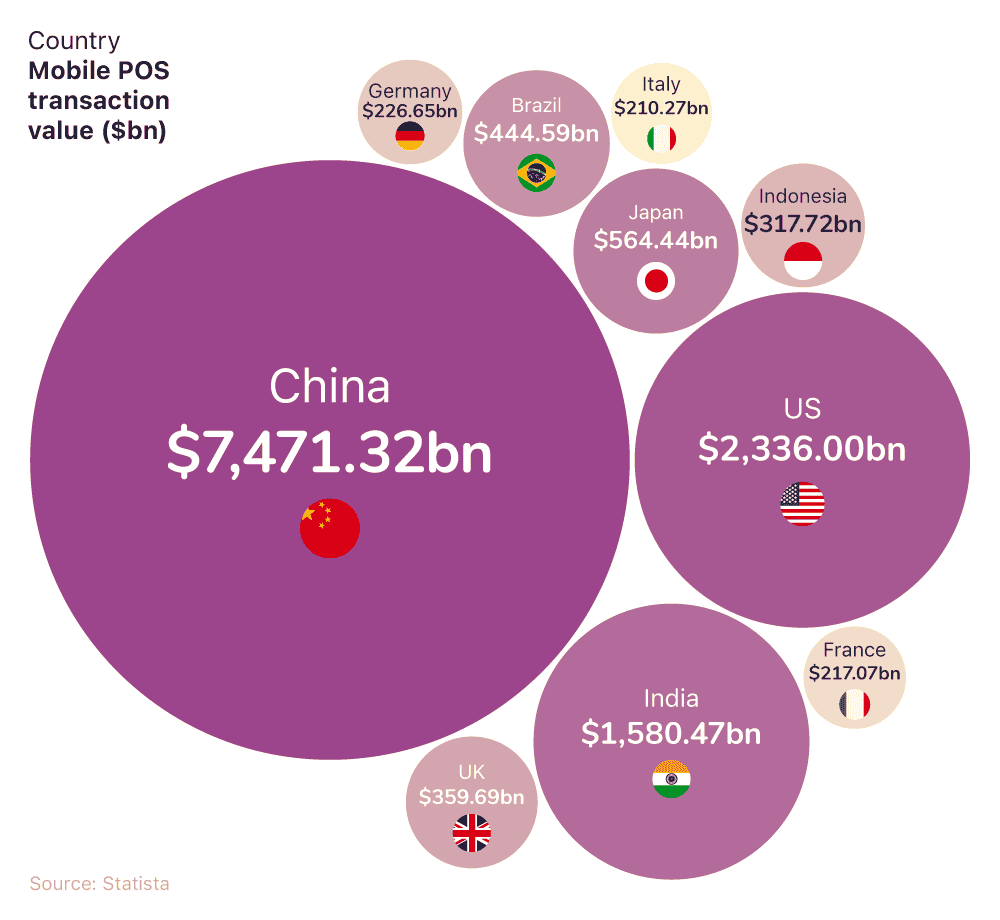
As of 2025, China had the highest mobile POS transaction value of all countries at more than $7,400 billion ($7.4 trillion). This was more than three times the amount Americans spent on mobile POS payments in the same year and almost five times India's total.
The UK, by contrast, spent $359.69 billion on mobile POS transactions in 2025. This was almost 6.5 times less than the US and roughly 20 times less than China.
Top 10 countries for mobile POS transaction value over time, 2018–30
| Country | 2018 | 2019 | 2020 | 2021 | 2022 | 2023 | 2024 | 2025 | 2026* | 2027* | 2028* | 2029* | 2030* |
|---|---|---|---|---|---|---|---|---|---|---|---|---|---|
| China | $1,493.55bn | $2,087.85bn | $2,838.64bn | $3,730.10bn | $4,713.81bn | $5,715.38bn | $6,655bn | $7,471.32bn | $8,134.60bn | $8,644.96bn | $9,021.53bn | $9,290.95bn | $9,479.54bn |
| US | $476.51bn | $621.55bn | $803.44bn | $1,026.96bn | $1,294.88bn | $1,606.63bn | $1,957.05bn | $2,336bn | $2,729.01bn | $3,119.32bn | $3,490.64bn | $3,829.69bn | $4,127.90bn |
| India | $255.9bn | $352.66bn | $479.46bn | $640.55bn | $837.32bn | $1,066.44bn | $1,318.84bn | $1,580.47bn | $1,835.09bn | $2,068.12bn | $2,269.70bn | $2,435.76bn | $2,567.12bn |
| Japan | $160.57bn | $195.4bn | $236.79bn | $285.53bn | $342.31bn | $407.64bn | $481.75bn | $564.44bn | $655.05bn | $752.39bn | $854.76bn | $960.02bn | $1,065.80bn |
| Brazil | $50.04bn | $73.72bn | $106.99bn | $152.1bn | $210.44bn | $281.36bn | $361.43bn | $444.59bn | $523.81bn | $593.29bn | $649.97bn | $693.51bn | $725.46bn |
| Indonesia | $67.67bn | $86.91bn | $110.87bn | $140.23bn | $175.57bn | $217.14bn | $264.77bn | $317.72bn | $374.66bn | $433.71bn | $492.71bn | $549.5bn | $602.25bn |
| UK | $52.45bn | $73.43bn | $101.45bn | $137.76bn | $182.98bn | $236.61bn | $296.66bn | $359.69bn | $421.53bn | $478.33bn | $527.39bn | $567.6bn | $599.14bn |
| Germany | $33.08bn | $45.51bn | $62.04bn | $83.55bn | $110.8bn | $144.1bn | $183.13bn | $226.65bn | $272.58bn | $318.29bn | $361.25bn | $399.47bn | $431.86bn |
| France | $34.56bn | $47.8bn | $65.2bn | $87.37bn | $114.51bn | $146.15bn | $181bn | $217.07bn | $252.09bn | $284.03bn | $311.53bn | $334.08bn | $351.82bn |
| Italy | $24.44bn | $35.85bn | $51.8bn | $73.29bn | $100.9bn | $134.25bn | $171.65bn | $210.27bn | $246.9bn | $278.94bn | $305.04bn | $325.1bn | $339.83bn |
Source: Statista’s Mobile POS Payments - Worldwide report
* Forecasted figures
Note: The mobile POS market refers to transactions made on any connected device to process purchases at the point of sale. This includes both traditional in-store and face-to-face transactions, such as digital wallets, buy-now-pay-later, account-to-account, and cryptocurrency purchases.
Analysis of mobile POS transactions over time suggests that, by 2030:
China will continue to dominate global spending on mobile POS payments, with spending rising by an estimated 26.9% compared to 2025 figures.
The UK’s expenditure on mobile POS payments could increase to almost $600 billion, a 66.6% rise over five years.
Mobile POS spending in the US may reach $4,127.9 billion ($4.1279 trillion) — almost double its 2025 level, yet only marginally less than China's 2022 spending.
Global average mobile POS transaction per user over time, 2018–30
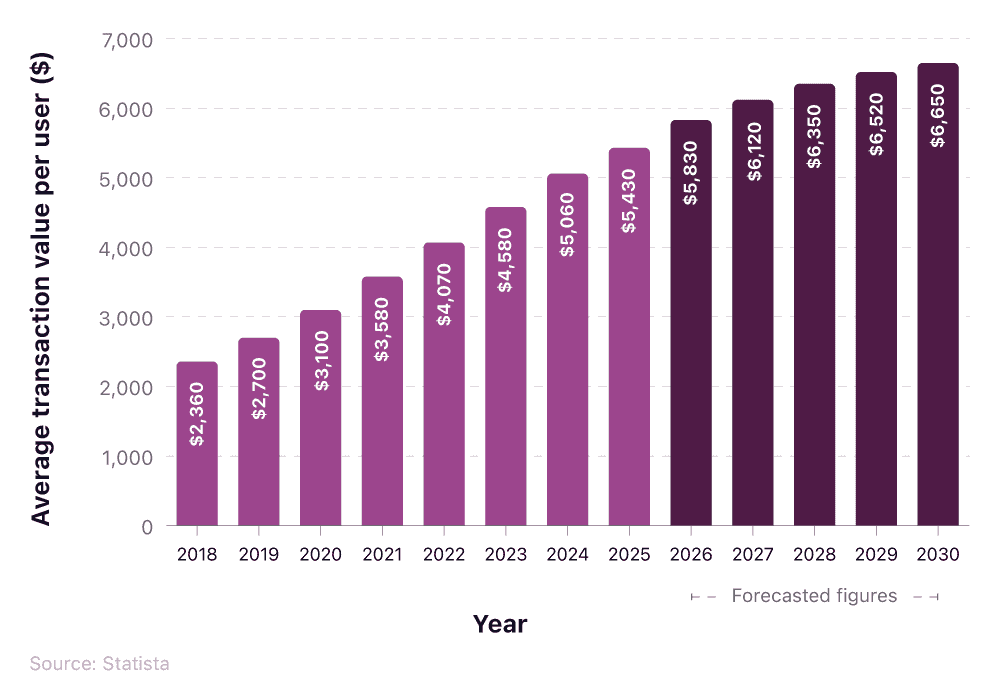
The average mobile POS user spent $5,430 globally in 2025. This figure has grown YoY since 2018, when the average was $2,360. This means the average amount consumers spent via mobile POS payments more than doubled between 2018 and 2025.
This upward trend is projected to continue in the coming years, with average spend per user reaching $6,650 by 2030.
Number of mobile POS users over time, 2018–30
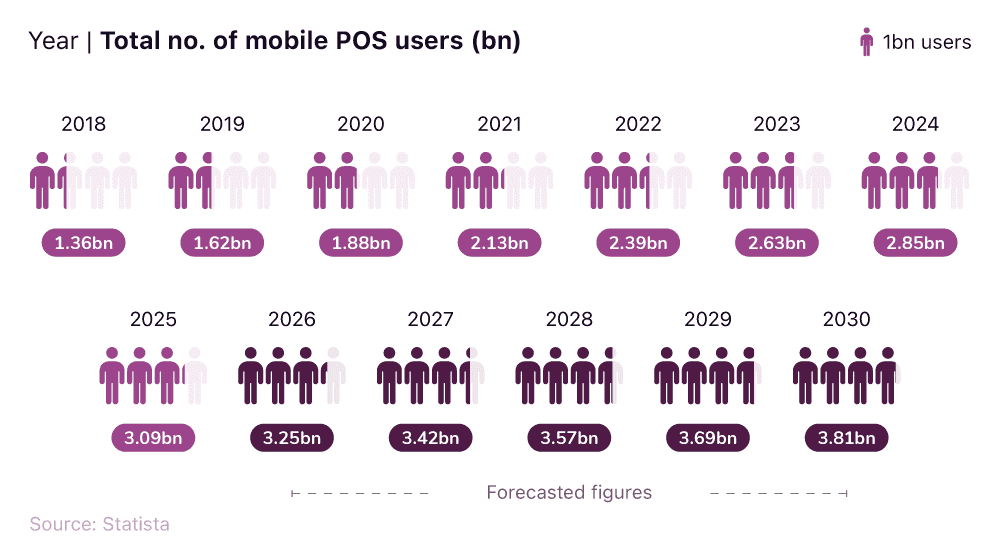
The number of mobile POS users worldwide more than doubled between 2018 and 2025, rising from 1.36 billion to 3.09 billion.
Forecasts suggest this upward trend will continue for years to come, with the number of mobile POS users expected to reach 3.81 billion by 2030.
Should this happen, the global mobile POS population would have almost tripled in 12 years.
Mobile POS payment penetration rate over time, 2018–30
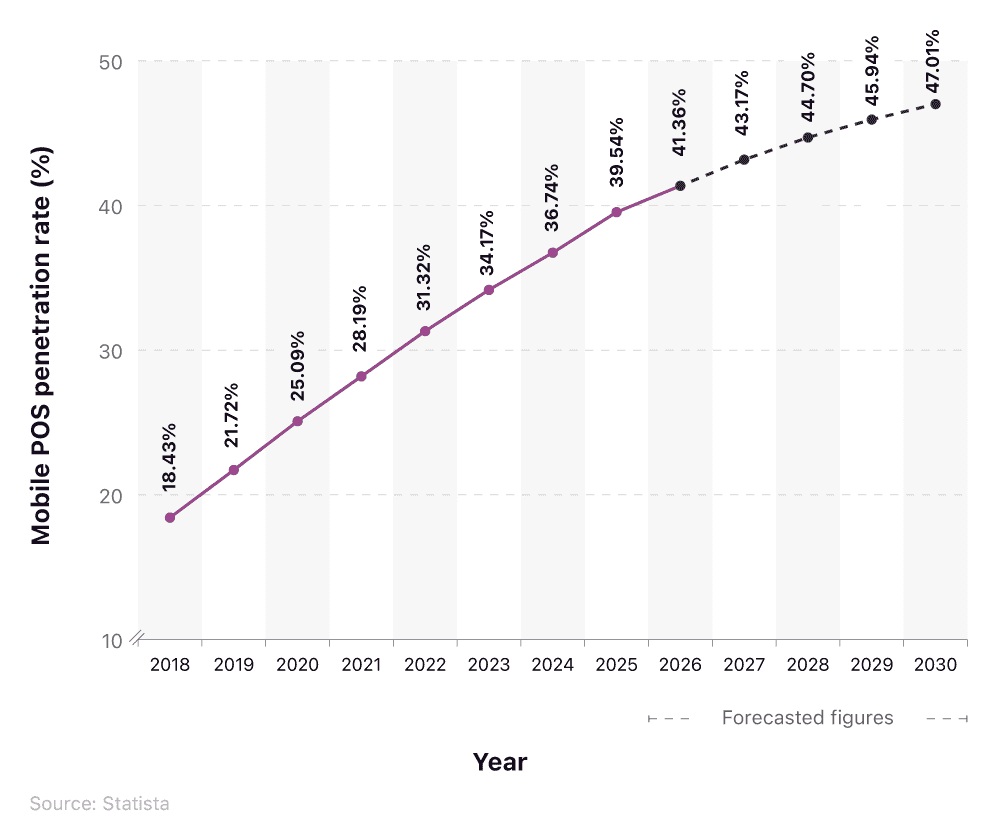
The global mobile POS penetration rate stood at 39.54% in 2025, with roughly two in five people worldwide using a mobile point of sale.
The proportion of people using mobile POS systems has risen YoY since 2018, when the figure was 18.43%. In seven years, the percentage of people using mobile POS payments more than doubled.
Should this upward trend continue, the mobile POS penetration rate is projected to reach 47.01% by 2030, meaning almost one in two people worldwide will be making mobile POS payments.
“By turning smartphones into payment terminals, mobile POS has expanded far beyond large retailers. This widespread availability is why nearly one in two people worldwide now use mobile POS to make payments.”
Most common payment methods for global mobile POS, 2024 vs 2025
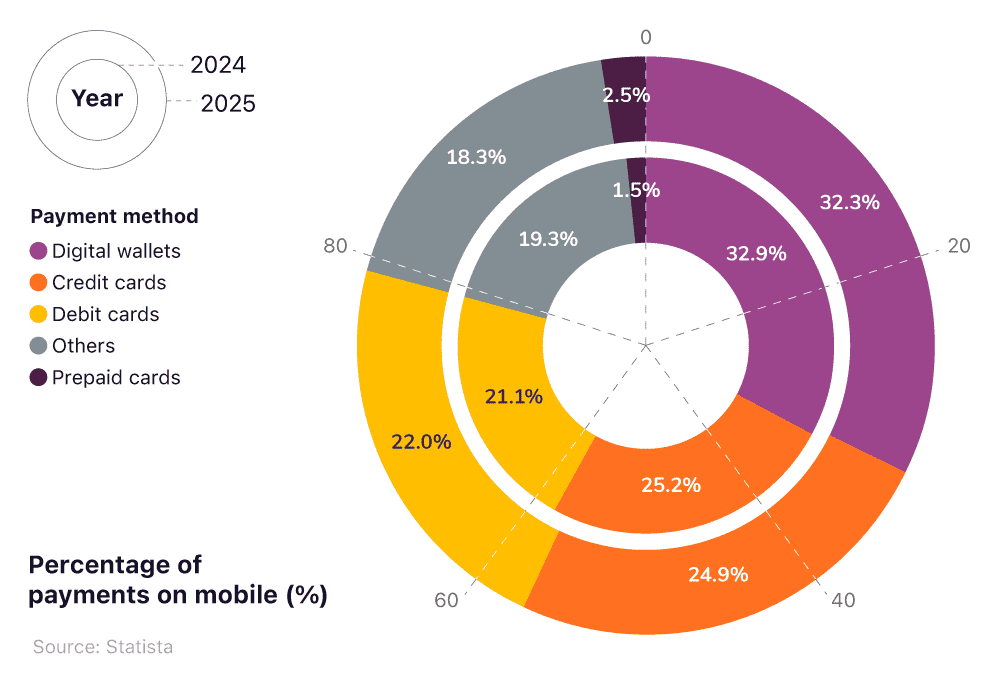
Globally, digital wallets were the most common payment method for mobile POS in 2025, accounting for 32.3%. This was marginally down on the previous year, when the respective figure was 32.9%. Yet, it remained the most popular method for mobile POS transactions across both years.
Analysis shows that:
Slightly fewer people used credit cards for mobile POS payments in 2025 compared to 2024 (24.9% vs 25.2%).
Debit cards were used by 22% of people in 2025, compared to 21.1% in 2024.
Prepaid cards were more commonly used for mobile POS transactions in 2025 than in 2024, but remained the least popular option among consumers (2.5% vs 1.5%, respectively).
Did you know?
According to our credit card statistics report, 64% of UK adults have at least one credit card.
Retail point-of-sale statistics
Retail POS market share
The global retail POS market share is expected to reach $34.4 billion by the end of 2026. This represents an increase of 117.72% since 2020, when the figure stood at $15.8 billion.
Market Research Futures predicts that the retail point-of-sale market could reach $141.19 billion by 2035, at a CAGR of 15.12% between 2024 and 2035.
UK convenience store POS market share
By contrast, the fuel and convenience store POS market share was valued at $1.106 billion in 2024.
With a forecast CAGR of 21.3% between 2025 and 2035, the global fuel convenience store point-of-sale market is anticipated to reach $9.258 billion by 2035.
Restaurant point-of-sale statistics
Restaurant POS systems market share
The global restaurant POS system market was worth around $12.3 billion in 2024. By 2035, this is projected to reach $30.48 billion (a rise of 147.81% in 11 years).
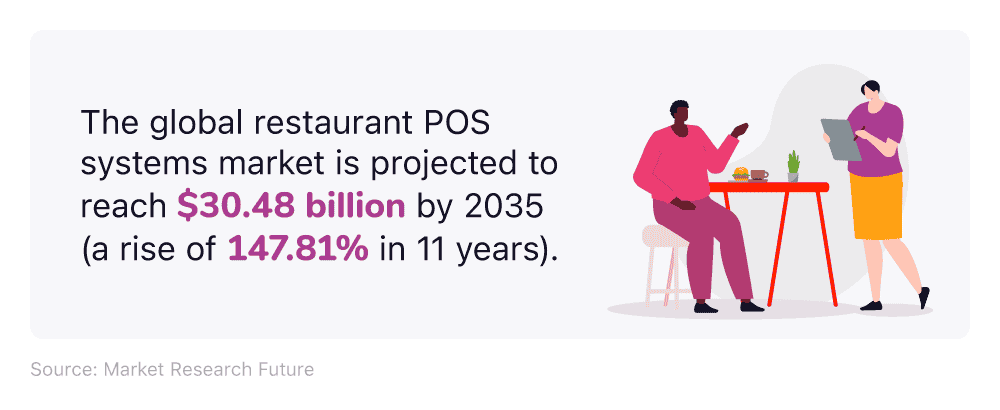
This would represent a CAGR of 8.6% between the forecast period 2025–35.
Most popular POS systems for restaurants
HospitalityTech found that 55% of restaurant owners surveyed in 2025 were considering a new or upgraded POS system, with 25% planning to do so.
The main business driver impacting POS investment decisions was supporting omnichannel ordering, cited by 100% of respondents. This was followed by adapting to changing consumer behaviour (60%) and upgrading to meet new payment technology (56%).
The 2025 HospitalityTech survey of restaurateurs found that:
The main features and functionalities driving POS investment are mobile ordering and payment integration (100%), cloud-based data storage and management (77%), and real-time reporting and analytics (75%).
The most common ways in which they are leveraging data via POS systems are personalised offers and promotions (100%), enhancing loyalty programmes (76%), and tracking menu performance to optimise offerings (60%).
These restaurant point-of-sale statistics would go some way toward explaining why POS systems are now seemingly ubiquitous in the restaurant industry.
POS buy now pay later statistics in the UK
BNPL trends in the UK
BNPL services were first launched in the UK in 2014. Since then, they have become a key growth area in payment markets, both domestically and globally.
Findings from the 2024 National Payments Study (NPS) found that:
25% of UK adults used BNPL at least once during that year (compared with 14% in 2023).
33% used BNPL monthly, a figure unchanged from the previous year.
The average BNPL spend is £114. This represents a 4% increase from 2023 and is significantly higher than the CPI inflation rate of 2.5%.
BNPL statistics by gender, age, and income
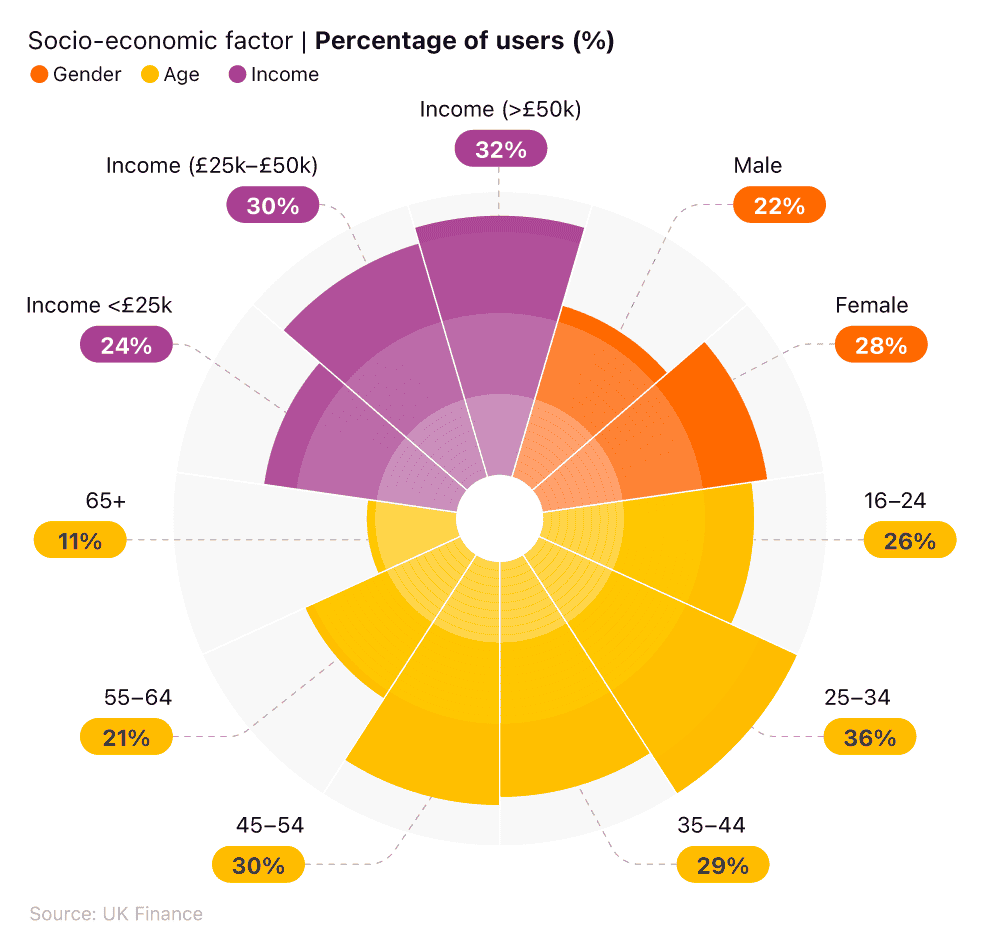
Demographic analysis by UK Finance found that:
Females tend to use BNPL services more than males (28% vs 22%, respectively).
Younger consumers tend to use BNPL payment methods more than their older counterparts, with the majority aged 25 to 34 (36%). This falls to just 11% of those aged 65 and above.
The use of BNPL tends to increase as personal wealth rises. For example, 32% of those earning more than £50,000 a year compared to 24% for those with an income of less than £25,000.
Most common BNPL purchases by category
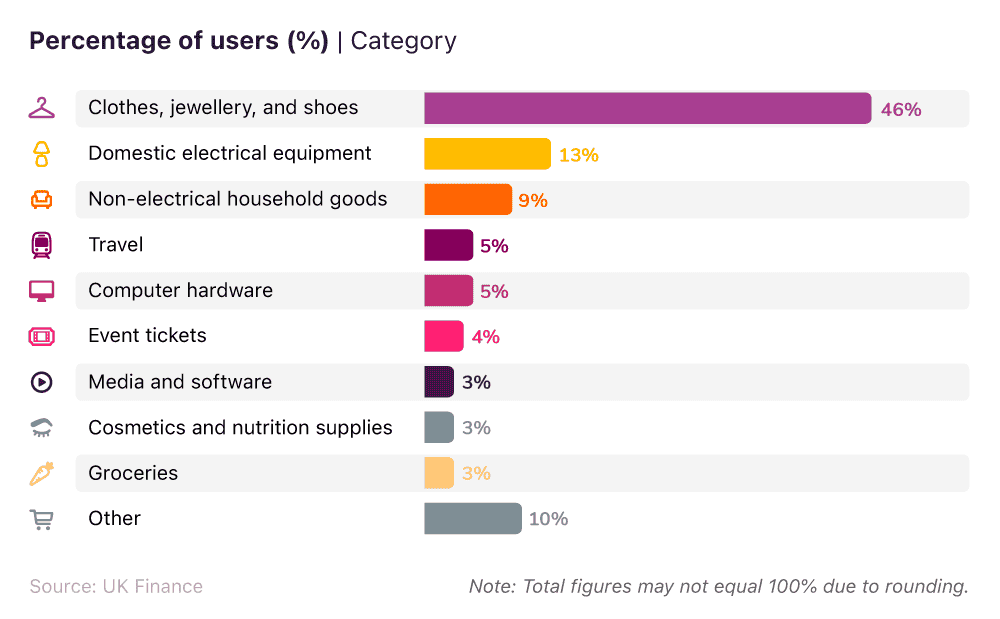
Almost half of BNPL purchases in 2024 were for clothes, jewellery, and shoes. At 46%, this was the largest spending category across all BNPL payments for the year.
Domestic electrical equipment (13%) and non-electrical household goods (9%) were the second- and third-largest categories for BNPL spending in 2024.
Other BNPL trends in the UK
UK Finance’s report on BNPL trends in the UK also reveals that, of those surveyed:
5% incurred a late payment fee in 2024.
41% were either not very concerned or not concerned at all about going into debt, compared with 31% who were worried about debt problems due to their BNPL use.
The most common BNPL services were Klarna, Clearpay, and PayPal’s Pay in 3.
Point-of-sale financing market size
As of 2025, eight of the top 10 buy now, pay later (BNPL) markets were in northwestern Europe. The largest of these (Sweden) had a BNPL market share of 25% in domestic eCommerce payments, meaning that one in four people used BNPL services to make online transactions.
This was followed by two other Scandinavian countries (Finland and Norway), each with a market share of 19%.
By contrast, the UK ranked 11th on the list, where 8% of people used BNPL services to make domestic eCommerce payments in 2025.
BNPL market share statistics for domestic eCommerce payments over time, 2016–25
| Country | 2016 | 2019 | 2020 | 2021 | 2022 | 2023 | 2024 | 2025 |
|---|---|---|---|---|---|---|---|---|
| Sweden | 12% | 25% | 23% | 25% | 24% | 21% | 23% | 25% |
| Finland | - | 8% | 12% | 13% | 13% | 13% | 16% | 19% |
| Norway | 5% | 13% | 15% | 18% | 18% | 15% | 18% | 19% |
| Germany | 3% | 18% | 19% | 20% | 23% | 21% | 20% | 18% |
| Australia | - | 8% | 10% | 11% | 14% | 15% | 15% | 13% |
| New Zealand | - | - | 10% | 10% | 10% | 11% | 13% | 13% |
| Belgium | 5% | 6% | 7% | 9% | 14% | 13% | 12% | 12% |
| Denmark | 5% | 7% | 8% | 12% | 12% | 12% | 11% | 11% |
| Netherlands | 6% | 8% | 9% | 12% | 13% | 11% | 10% | 10% |
| Switzerland | - | - | - | - | - | - | - | 8% |
| UK | 1% | 3% | 5% | 6% | 8% | 7% | 7% | 8% |
| US | - | 1% | 2% | 4% | 5% | 5% | 6% | 6% |
| Canada | - | - | - | 3% | 6% | 5% | 5% | 5% |
Source: Worldpay, GlobalData, McKinsey & Company, World Bank and IMF via Statista’s Market share of buy now, pay later (BNPL) in domestic e-commerce payments in 43 countries and territories worldwide from 2016 to 2024 report
BNPL market share statistics for domestic eCommerce payments have fluctuated over time across many countries.
For example:
The proportion of residents using BNPL services for domestic online transactions in Sweden more than doubled between 2016 and 2019. Yet, this figure has remained above 20% ever since and has not yet exceeded 25%.
Data for Finland show that its BNPL market share more than doubled, from 8% to 19%, between 2019 and 2025.
The relative popularity of domestic BNPL services in Norway almost quadrupled between 2016 and 2025 (from 5% to 19%).
Historically, the UK saw steady growth in its BNPL market share, from 1% in 2016 to 6% in 2021. Yet, since then, this figure has remained between 7% and 8%.
Did you know?
Online payment gateways are a great option for running a business if you need a secure way to accept payments. They can include payment processing portals found in online stores, as well as various card payment solutions or POS terminals used in standard brick-and-mortar businesses.
Cloud point-of-sale statistics
Cloud point-of-sale market size
Grand View Research estimated the cloud point-of-sale market size at $36.23 billion in 2025. By 2033, they expect this to more than double to $77.92 billion, with a 10% CAGR between 2026 and 2033.
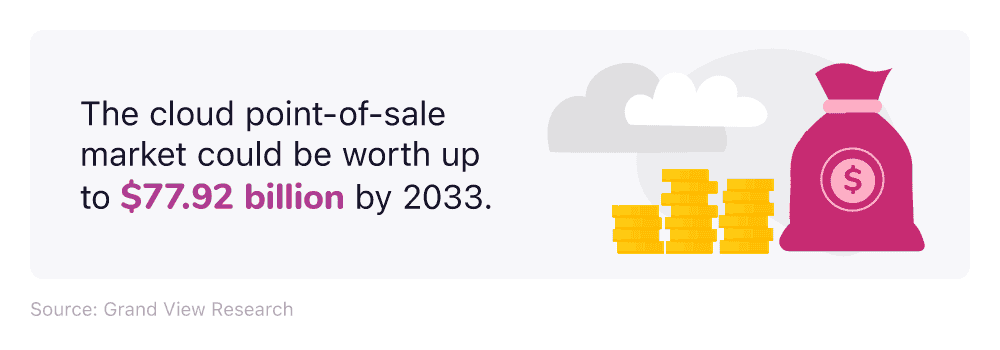
They also concluded that, in 2025:
North America held the largest revenue share at 33.1%.
By component, the hardware segment accounted for 61% of the overall cloud point-of-sale market.
The fixed POS segment held the largest revenue share by type.
Healthcare is expected to have the fastest CAGR growth among end uses between 2026 and 2033.
Evolution of POS systems
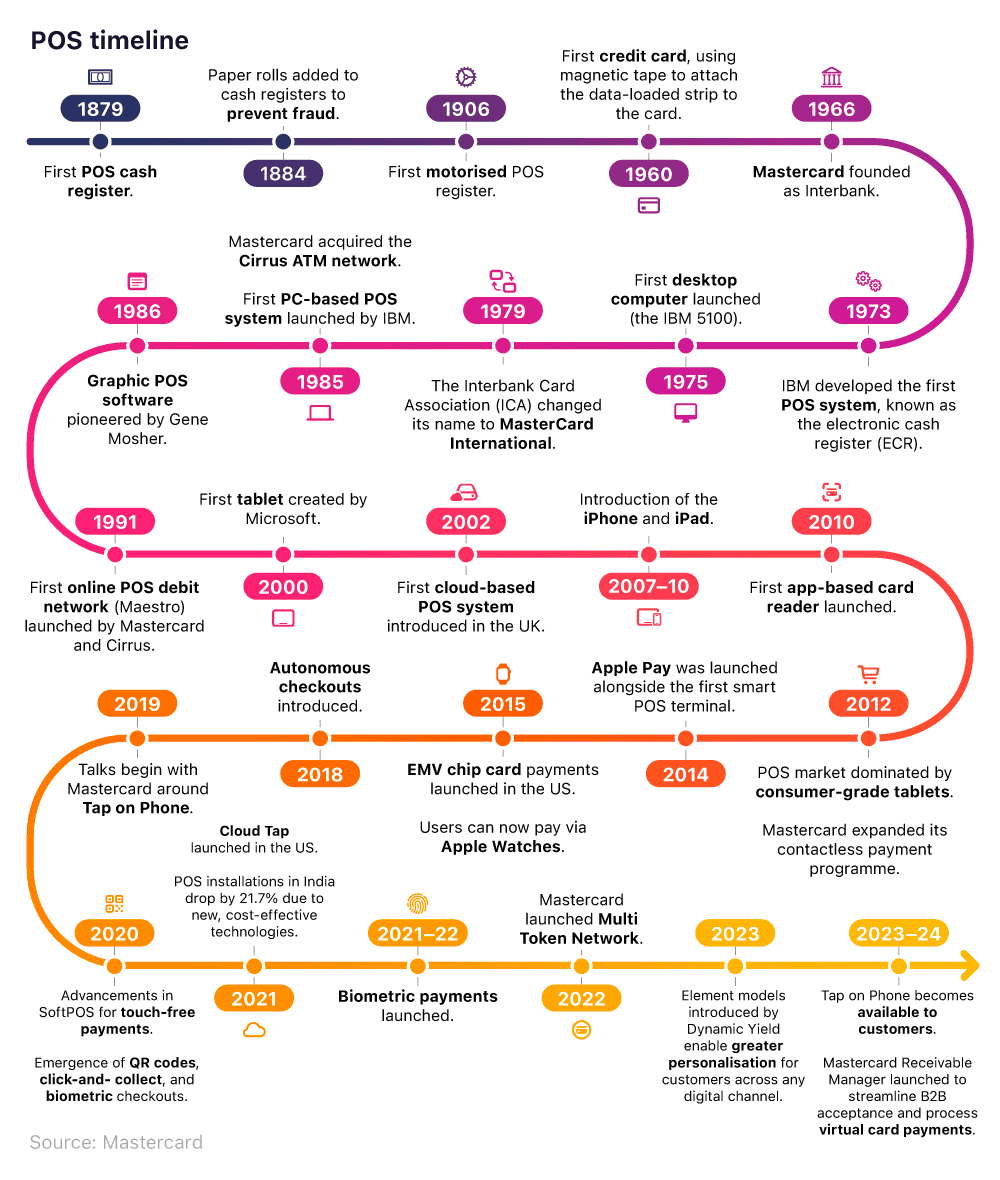
POS systems have come a long way since the first POS cash register was introduced in 1879.
Yet it wasn’t until 81 years later that the world’s first credit cards were introduced. The idea of credit was first explored by Frank McNamara and Ralph Schneider in 1950 with the Diners Club card. However, it would take another 10 years before credit cards were formally introduced.
1973 saw the world’s first POS system, followed by the first computer-based POS system 12 years later, both of which were attributed to IBM.
In 1991, Mastercard and Cirrus launched the first online POS debit network (Maestro).
How POS systems have changed over time, 1879–present day
What is SoftPOS?
SoftPOS is an abbreviation for Software Point of Sale) and refers to an application that turns a smartphone or tablet into a contactless payment terminal.
Cloud-based POS systems were introduced in the UK in 2002.
Technological development by companies such as Apple throughout the 2000s helped to facilitate the move towards an increasingly contactless society. Apple Pay was introduced in 2014 alongside the first smart POS terminals, and by 2018, autonomous checkouts were appearing in shops and stores in various locations.
2020 saw the introduction of touch-free payment methods, such as QR codes, click-and-collect, and biometric checkouts, with Mastercard’s Tap on Phone available to consumers by 2023–24.
What is an autonomous checkout?
An autonomous checkout is a technologically operated shopping system that allows you to walk into a store, take your items, and leave without scanning barcodes or waiting to be served by a cashier. Instead, artificial intelligence (AI), cameras, and sensors track what you take and automatically charge it to your account when you leave the shop.
Global popularity of “point of sale” and “POS” as relative search terms over time, 2004–26
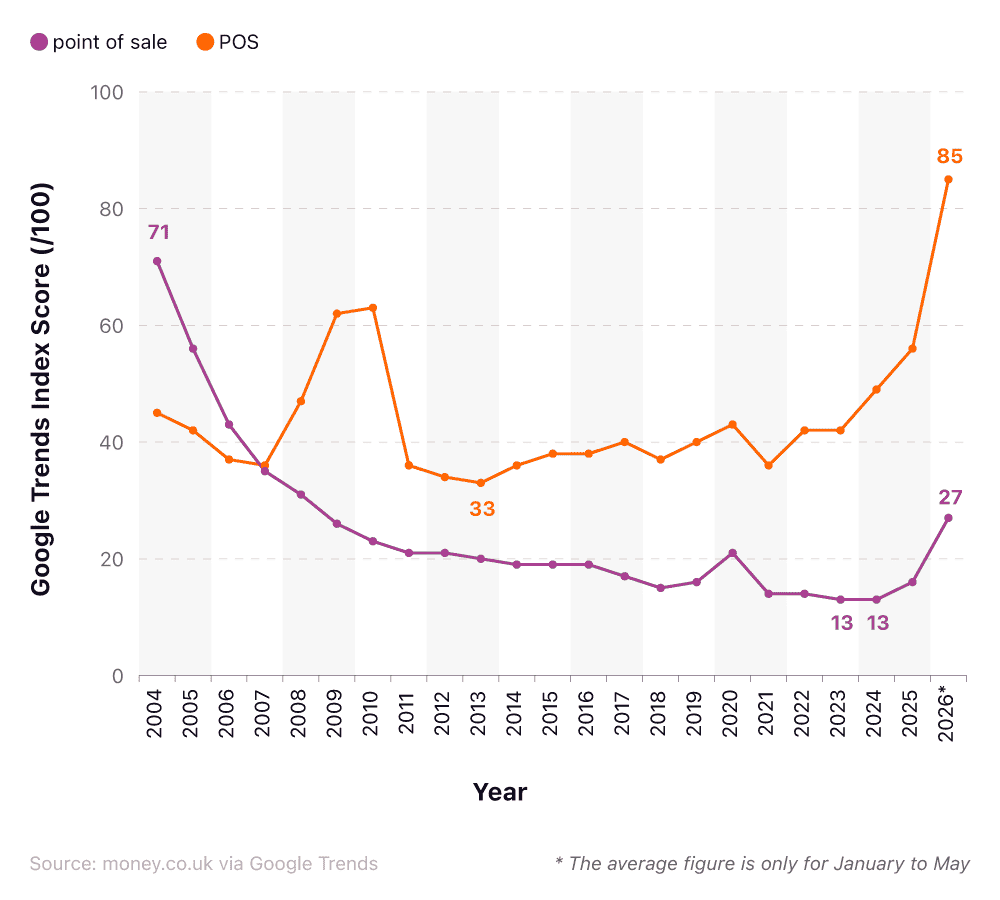
Note: Google Trends index score is a relative measure of popularity, not an absolute one. It indicates how popular search terms are, relative to one another (with an index score out of 100), rather than a measure of average monthly search volumes. The closer the number is to 100, the more “popular” that word is in relative terms.
As of 2026, the term “POS” had an average Google Trends index score of 85, making it around three times as popular as “point of sale” as a search term, relatively speaking.
Search interest for “POS” fluctuated in popularity between 2004 and 2026, ranging from a score of 33 in 2013 up to its peak in 2026.
“Point of sale” was generally more popular in the 2000s (relative to other decades), with an index score of 71 in 2004. A YoY decline led to a score of 15 in 2018. This represented a 78.9% decrease in the search term's relative popularity over 14 years.
“The clearest shift is that payment hardware is disappearing into devices people already own. Where businesses once needed a dedicated terminal, a standard smartphone can now do the same job.”
Point-of-sale FAQs
The global POS industry was worth an estimated $38.56 billion in 2025 and is expected to grow to $44.6 billion in 2026 and to $138.92 billion by 2034.
There are five main types of POS systems:
POS terminals: a basic system designed to process credit and debit card payments safely and securely.
Retail POS system: a more fully featured system that can also record details of sales and is designed for stores and pop-up shops.
Restaurant POS system: a more complex system that may include features such as table management, kitchen display systems, and online food ordering.
Mobile POS system: a software-based POS system designed to work on mobile devices, such as smartphones and tablets.
Cloud POS systems: an internet-based POS system that is relatively easy to set up, use, and access your data via the web.
There are seven main types of POS systems for restaurants:
In-store POS systems: Wi-Fi-connected, hardwired devices that sit permanently in restaurants and usually take payments, track sales, do inventories, and perform analytics.
Kiosk POS systems: also known as self-service POS systems, let customers make purchases and check out on their own, without assistance from an employee.
Mobile POS systems: allow customers to make payments quickly and reliably from their phones while also enabling sales and inventory analytics.
Touchscreen POS systems can be used on a handheld device. Their flexible, portable, easy-to-use digital display enables them to take mobile payments.
Cloud-based POS systems: hosted entirely online, in the cloud. This lets you log in, manage, update, and track sales data, provided you have a Wi-Fi connection.
Open-source POS systems: web-based software that can be fully customised and used for any device to meet a company’s specific needs.
Multichannel POS systems: can integrate sales, employee, operational, and inventory data across different sales channels, such as online, in-store, emails, and company newsletters.
Square was the most commonly searched POS system in the UK in 2026, with a Google Trends index score of 77, compared to other POS systems.
The biggest POS system by market share is Square (28.07%), followed by Toast (23.33%).
Methodology and sources
Most common POS systems by search interest over time
Google Trends data was collected for the five most common POS systems by market share, using data from 6sense.
Monthly data was collected for each POS system between January 2004 and May 2026, and an average was calculated for each year.
money.co.uk surveyed 500 small business owners on their use of POS systems. This survey was carried out in April 2026.
https://www.fortunebusinessinsights.com/point-of-sale-pos-market-106336
https://www.precedenceresearch.com/point-of-sale-software-market
https://www.marketdataforecast.com/market-reports/europe-pos-terminals-market
https://www.association-secure-transactions.eu/industry-information/pos-terminal-numbers-europe/
https://www.money.co.uk/business/pos-systems-for-small-businesses
https://www.contractsfinder.service.gov.uk/Search/Results
https://www.statista.com/forecasts/997880/payments-at-points-of-sale-by-type-in-the-uk/
https://6sense.com/tech/pos-systems
https://www.statista.com/forecasts/997928/biggest-contactless-payment-brands-at-pos-in-the-uk/
https://www.statista.com/forecasts/997117/biggest-contactless-payment-brands-at-pos-in-the-us/
https://s29.q4cdn.com/628966176/files/doc_financials/2025/q4/Block_Investor-Presentation-4Q25.pdf
https://investors.block.xyz/financials/quarterly-earnings-reports/default.aspx
https://investors.fiserv.com/financial-information/quarterly-results
https://investors.fiserv.com/static-files/f06e921f-8e4b-445e-81f5-70e8b6e9404a
https://www.shopify.com/news/shopify-q4-2025-financial-results
https://s28.q4cdn.com/517092977/files/doc_financials/2026/q3/Investor-Deck-FY26-Q3.pdf
https://investors.lightspeedhq.com/financials/financial-reports/
https://www.marketresearchfuture.com/reports/uk-mobile-pos-market-61026
https://www.mordorintelligence.com/industry-reports/united-kingdom-mobile-payments-market
https://www.experian.co.uk/consumer/identity/app-fraud.html
https://www.statista.com/outlook/fmo/payments/digital-payments/mobile-pos-payments/worldwide
https://www.marketsandmarkets.com/Market-Reports/retail-point-of-sale-pos-market-49453884.html
https://www.marketresearchfuture.com/reports/retail-point-of-sale-market-29757
https://www.marketresearchfuture.com/reports/fuel-convenience-store-pos-market-10374
https://www.marketresearchfuture.com/reports/restaurant-pos-systems-market-21747
https://hospitalitytech.com/2025-pos-software-trends-study?email-confirmed=1733337756386
https://www.statista.com/statistics/1233850/online-bnpl-penetration-country/
https://www.marketresearchfuture.com/reports/cloud-pos-market-7709
https://www.grandviewresearch.com/industry-analysis/cloud-point-of-sale-market-report
https://www.mastercard.com/content/dam/public/mastercardcom/gateway/other/PoS_Evolution.pdf
https://www.mastercard.com/brandcenter/us/en/brand-history.html
About Joe Phelan
Joe is an experienced writer, journalist and editor. He has written for the BBC, National Geographic, and the Observer. As a business expert, his work frequently spotlights the ventures and achievements of small business owners. He writes a weekly insight article for money.co.uk, published every Tuesday.
View Joe Phelan's full biography here or learn more about our editorial policy