Our best euro exchange rates
Convert GBP to EUR and find the best Euro exchange rates
Travel FX Travel Money

More Information
| Available Direct | |
| UK Residents |
The Currency Club Travel Money
More Information
| Available Direct | |
| UK Residents |
Sterling FX Travel Money

More Information
| Available Direct | |
| UK Residents |
NM Money Travel Money

More Information
| Available Direct | |
| UK Residents |
eurochange Travel Money
More Information
| Available Direct | |
| UK Residents |
Post Office Travel Money
More Information
| Available Direct |
Covent Garden FX Travel Money

More Information
| Available Direct | |
| UK Residents |
Currency Calculator

Join our personal finance newsletter for top deals and insights
You can unsubscribe from emails at any time. For more information about how we process your information, please read our Privacy Notice.
How to find our best euro exchange rates
Follow these tips to help you get the best deal when converting pounds to euros.
Don't buy euros at the airport
Try to plan ahead if you are buying euros because airport exchange kiosks are not the best place to buy euros.
Compare rates
Before you make any decisions, it’s essential to compare euro rates from a range of providers. Use our exchange rates table above to ensure you are getting the best deal.
Select your provider
Once you’ve found the best euro exchange rate, visit the provider’s website and review the details to make sure it suits your needs.
Order online or collect
If you are happy with the euro exchange rate you’ve found, fill in a form online to order the money or collect it in person. Always check delivery costs as these can significantly increase the cost of a deal.
Pros and cons of taking cash with you
Pros
Cons
How far will your euros go?
The cost of living varies in different European countries, so if you take €500 on holiday then you’ll get more for your money in some countries compared to others. We looked at figures from Numbeo and compared the average cost of living in 2026 to see how far your euros would go.
For example, in France you are likely to pay €60 for a three-course meal for two in a mid-range restaurant but in Bulgaria the cost of the same meal will probably be closer to €40. In terms of local beer, you can expect to pay around €3 in Spain but €5 in Austria. And if you like a coffee in the morning, you can expect to pay around €1.77 for a regular cappuccino in Italy, compared to €3.61 in Germany. Aside from food and drink, taxis also vary in cost as you’ll only pay €0.94 per 1km on a normal tariff in Portugal, but in Greece it’s €1.00 for the same fare.
Find out more by visiting our 'going on holiday' hub page.
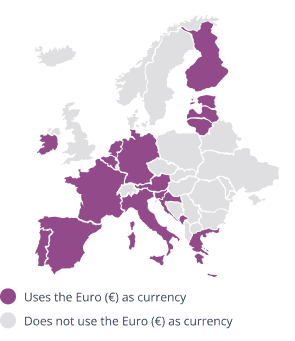
Where can I spend my euros?

What are the top alternatives to buying travel money?
Travel credit cards - i.e. the ones with no foreign transaction fees - offer two key advantages over travel money:
Great exchange rates - when you spend on a travel credit card you get the American Express, Mastercard or Visa exchange rate, which is about the best you can find as a regular consumer
Purchase protection – for purchases costing £100 to £30,000, you're covered by Section 75 of the Consumer Credit Act, meaning if something goes wrong you can make a claim with your card provider should the vendor fail to pay up
However, not everywhere accepts travel credit cards and using them at a cash machine abroad can come with hefty fees. It can also be easier to overspend on a credit card, leaving you with debts on which interest is charged.
Currency cards and travel bank accounts let you spend overseas without being charged a foreign transaction fee. Their key strengths are:
Great exchange rates – the best card providers will pass on the Amex, Mastercard or Visa rate to you without adding extra charges
No charges for some ATM withdrawals overseas - if you need extra cash on holiday, some providers let you make a number of withdrawals per month or withdraw up to a certain amount without being charged. Watch out for local ATM fees though, as these might still apply
The downsides include that there can be limits on how much you can withdraw abroad using a travel money card, and that they're not accepted quite as widely as cash. Some travel current accounts also come with fees.
Prepaid travel cards can be loaded with currency and used abroad without paying foreign exchange fees. You can load a prepaid card with a specific foreign currency or a variety of different currencies, depending on your travel plans. The key advantages are:
Low or no fees to use abroad – prepaid travel card providers can charge far less than traditional banks for overseas usage
Safer than carrying cash - you can cancel or freeze the card if it's lost or stolen, protecting your balance
However, you’ll need to watch out for general usage fees, which often apply when you load the card with cash and may also be charged monthly.
What are the top alternatives to buying travel money?

Travel credit cards

Travel money cards

Prepaid travel cards
FAQs
There is no guarantee that the best euro rate will get better or worse, so if you’ve found a deal that suits you, it’s generally best to go ahead and purchase the euros you need. It’s important not to leave it too late in case the money cannot be delivered in time.
If you are looking for the best exchange rate for euros, compare the latest rates by using our table above.
The exchange rates you can find online are usually better than the best euro rate on the high street.
The Post Office usually offers one of the most competitive high street euro exchange rates, but you can still find better rates online.
Yes, you can use your credit card to purchase foreign currency. However, bear in mind that it will count as a cash advance and you'll be charged a cash advance fee, as well as daily interest, until it's paid off.
Commission is a fee a travel money provider charges you for exchanging the money into a foreign currency.
About our comparison
We include every company that gives you the option of buying currency online. Discover how our website works.
We have commercial agreements with some of the companies in this comparison. We get paid commission if we help you take out one of their products or services. Find out more here.
You do not pay any extra and the deal you get is not affected.
About the author

Learn more about travel money



Didn't find what you were looking for?
Below you can find a list of currencies to exchange
Other products that you might need for your trip
We’ve been featured in





Customer Reviews

Everything you need to gain credit for…

Very fast and efficient. From start to finish it was easy to follow the application.
Great website
About Cathy Hudson
Cathy has been a journalist since 2001, starting her career writing about mortgages and property then becoming editor of a mortgage and home buying magazine. Before going freelance in 2018 she worked at Which? for 12 years, first as a money researcher and writer then as an editor in the money, home, tech and cars teams.
View Cathy Hudson's full biography here or learn more about our editorial policy