Meet Matt and Teri: the ethically minded founders shaking up the chocolate aisle

After spotting an opportunity to make chocolate more fun, Matt and Teri Legon founded GNAW. Fifteen years on, the brand’s chocolate is now available in 21 countries.
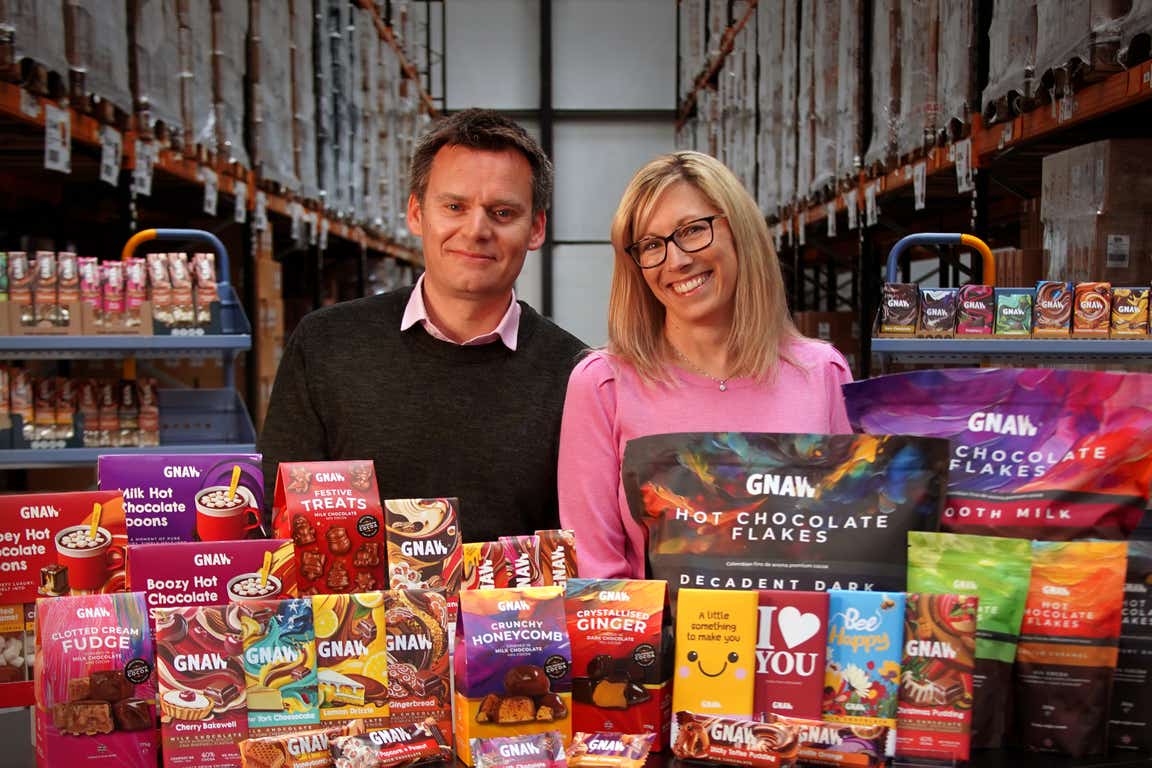
GNAW has grown from its original 900-square-foot space to a 31,000-square-foot factory.
Business name: GNAW
Industry: Confectionery
Founded in: 2011
Top business products: Asset finance
Key learning: “For aspiring founders, my advice is simple: believe in your idea, but remain disciplined.”
The chocolate market is crowded. With hundreds of brands competing for attention and precious shelf space, standing out can be difficult, particularly for a new business.
When Matt and Teri Legon launched GNAW in 2011, they saw an opportunity to do things differently. They felt chocolate had become too predictable, and were convinced there was space to bring more fun, creativity and playfulness to the category.
But building a chocolate brand from scratch comes with plenty of challenges. Along the way the pair have had to learn how to make chocolate, navigate costly mistakes, and make the leap from a small operation to an international brand.
We spoke to Matt and Teri about the lessons they’ve learned over 15 years in business, how they’ve funded GNAW’s growth, and what it takes to build an independent food brand in a crowded market.
What originally motivated you to start GNAW, and what gap did you feel existed in the chocolate market at the time?
Teri: We felt there was a lack of fun, uniqueness and playfulness in chocolate. You had the everyday major brands, but the flavours weren’t particularly inspiring. Everything felt very similar, with the same products appearing again and again. It all felt a little flat, and we saw an opportunity to challenge the market and shake things up.
We wanted to be creative with flavours and packaging and bring something genuinely different to the category. At the time, very few brands were doing that. Being playful and showing just how amazing chocolate could be was our biggest driver.
When you first launched the business, what were some of the biggest challenges you faced in getting the brand off the ground?
Matt: There were already plenty of products on the shelves, and we had to convince retailers to make space for ours. Many businesses are competing for that shelf space and investing heavily to secure it, so getting that initial traction can be difficult. There were certainly some sleepless nights wondering whether we could build enough volume to make the business commercially viable.
We’ve definitely been through the mill. I always remember our first packaging run, which cost £5,000, being completely wrong because the ingredients on the back were incorrect. We had to throw the whole lot in the bin, which was a big lesson when money was already tight.
In those early days, we also didn’t know how to make chocolate, so we had to learn as we went along. Around 90% of our first products weren’t sellable because we didn’t understand the complexities of chocolate. We built from the ground up through learning on the go.
We made plenty of mistakes along the way, but that’s par for the course. You have to learn from them, try not to make the same mistakes twice, and keep building. We started with one retailer, then a distributor, and gradually built from there while continuing to innovate and stay true to what we’re good at. Slowly but surely, we built the company.
GNAW has grown from an ambitious startup into a brand stocked by major retailers and exported internationally. What have been the key moments or decisions that shaped that growth?
Teri: About three months into our journey we got our first distributor on board, which was incredibly exciting. But with that came the challenge of producing at scale, and we weren’t really prepared for it! We were still learning how to make chocolate and dealing with packaging issues, so we had to learn quickly and solve problems as they arose. It forced us to grow very quickly.
Within our first year, we had to decide whether to continue at the pace we were going and remain a cottage industry, or make the bold move to a larger factory to accommodate all the interest we were receiving. We chose to move to a larger factory, which was a major turning point for the business.
Several years later, we found ourselves facing a similar decision. This time, it wasn’t just about increasing our production capacity; we also wanted to evolve from a small, young brand into something more established. By then, we had developed a real passion for sustainability and protecting the planet, so we made another bold move into a new factory. We upgraded our machinery and capabilities and began moving towards paper packaging, which was an important step in the next stage of GNAW’s growth.
Matt: We’ve gone from 900 square feet to 6,500 square feet to 31,000 square feet. It’s been a 15-year journey, but now we’ve certainly got the space to grow.
Sustainability and ethical sourcing are clearly central to the business. How have you approached balancing those values with the commercial realities of scaling a manufacturing brand?
Matt: When you’re heavily focused on sustainability and ethical sourcing, the most important thing is making sure your supply chain is rigorous and that we can prove what we’re saying. We really care about being an ethical brand, so we need to make sure we’re living up to our own high standards.
When circumstances change, whether that’s major conflicts around the world or something like COVID, we have to keep reassessing our supply chain. That means not cutting corners. We’re clear about being an ethical company and doing things the right way because, to us, that’s what the brand is about. It isn’t just about selling a product.
Teri: We’ve made the decision to put sustainability ahead of profits, and sometimes that can be really tricky. But in the long term, I believe that’s the best thing to do, not just for our customers and the people who believe in us, but also for the planet.
Matt: Yep. We always say that we need to make sure we don’t leave a lasting mark on this planet.
Your branding has always leaned into fun and playfulness alongside premium chocolate. How important has that personality been in helping GNAW stand out in a competitive market?
Matt: When you’re one of hundreds of brands on the market, you have to stand out. You have to be different and offer something novel. Chocolate is supposed to be fun; it’s meant to be a pleasure.
At the same time, we care deeply about being ethical and sustainable in our supply chain and making sure we don’t leave a negative footprint on the world around us. I think it’s about finding a balance between creating the sense of fun that chocolate should bring while also communicating our ethical values as a brand.
That can be difficult because fun and ethics aren’t always seen as naturally fitting together. However, that’s a challenge we’ve embraced, and it’s something we continue to navigate in everything we do.
What financial products have supported you in growing and running the company?
Matt: Over the last 15 years, we’ve built three factories, each one significantly larger than the last, and that has required substantial investment. As a privately owned business, we’ve relied on asset finance and the cash flow generated from our commercial activities.
It can be challenging when you’re required to spend significant sums of money. We’ve used more than £1 million in asset finance, particularly for new machinery. When we built our current factory in 2022, we invested a total of £1.7 million in the machinery, the factory itself, air handling units and solar panels. It was a substantial investment.
To spend that level of money without external investors is something we’re very proud of. We’ve managed our cash flow carefully, and being a commercially successful business has certainly helped. Our business banking partner, HSBC, has also been a strong supporter throughout the journey.
It’s a proud feeling to know that we’ve built everything we have today independently and achieved it through our own hard work and determination.
Looking back over the past 15 years, is there anything you would approach differently if you were to build GNAW again today?
Matt: I think everybody would say there are many things they would do differently, and I’d say the same. From the outset, we didn’t focus enough on marketing or brand awareness. We didn’t spend enough time going out to consumers and helping them understand who we are and what makes us different.
We operate in a saturated market, with hundreds of brands all competing for shelf space. When shelves are already full, finding space for your product usually means replacing someone else’s, and that’s a difficult process. Looking back, marketing and brand-building are definitely areas I would have focused on much earlier.
I also think it’s a mistake to assume customers will stay with you forever. We made that assumption many times. Some customers did remain with us for years, but eventually another company will come along with a different price, a different product or a new approach. Markets are constantly evolving, and businesses have to evolve with them.
Trust is another important lesson. Would we trust as many people again? Probably not. We’ve been burnt a number of times, and that experience has taught us to be more cautious. At the same time, business fundamentally relies on trust, so it’s important to maintain that balance. You have to trust people, but when situations become more complicated, you also need to be prepared to protect the business.
What advice would you give to aspiring founders looking to build an independent food or drink brand in today’s market?
Matt: Fundamentally, it’s an incredibly tough and competitive market. To succeed, businesses have to be bold, different and intriguing. Young brands also need to find creative ways to market themselves without spending excessive amounts of money.
There are countless marketing companies promising huge results while delivering very little in return, often at a significant cost. Many businesses are encouraged to spend tens of thousands of pounds on marketing initiatives that ultimately fail to generate meaningful awareness or traction.
For aspiring founders, my advice is simple: believe in your idea, but remain disciplined. Financial caution is essential. Some people may see that as being overly tight with money, but careful spending is often what allows businesses to remain independent and privately owned.
Our company has now grown through three factories, expanded into 21 countries and retained 100% ownership throughout that journey. Maintaining that independence was always a priority. Avoiding external investors meant we retained control over how the brand was built, how decisions were made and how profitability was achieved.
Building a successful business requires vigilance, discipline and a close eye on every expense. Spend when it’s necessary, find innovative ways to stand out, and focus on creating a brand that inspires curiosity and captures attention. In a crowded market, being different is what makes people take notice.
About Joe Phelan
Joe is an experienced writer, journalist and editor. He has written for the BBC, National Geographic, and the Observer. As a business expert, his work frequently spotlights the ventures and achievements of small business owners. He writes a weekly insight article for money.co.uk, published every Tuesday.
View Joe Phelan's full biography here (opens in a new tab) or learn more about our editorial policy (opens in a new tab)