Meet Daniel: the entrepreneur bringing virtual production to North Wales

Daniel Parry Evans launched Vedri to make virtual production technology more accessible to businesses and content creators in North Wales.
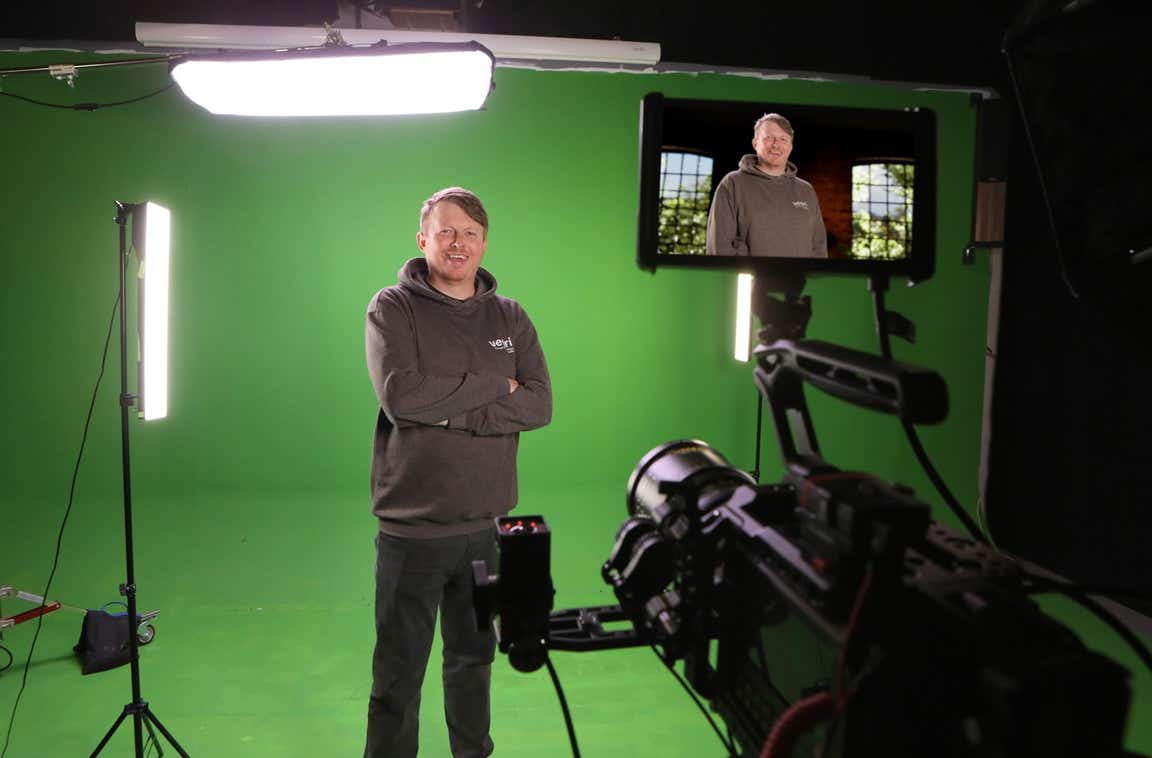
Daniel has worked across Wales’ creative and broadcast industries, including roles with BBC Sport, Cwmni Da and Rondo Media.
Business name: Vedri
Industry: Virtual production
Founded in: 2025
Top business products: Business loan
Key learning: “Providing people with the opportunity to learn and build their skills locally gives them a strong foundation and a stepping stone to move on to larger stages.”
Daniel Parry Evans has been working in the creative industries since he was 16, taking on various roles across Wales’ broadcast and production sector, while also developing and running his own creative agency.
That experience has given him a clear understanding of the challenges facing the sector, including the limited access to virtual production technology outside the UK’s major production hubs.
Which is why he launched Vedri.
Based in North Wales, the studio is helping make virtual production more accessible to businesses and content creators in the region.
Supported by a £15,000 Start Up Loan, Daniel has invested in the specialist equipment needed to get Vedri off the ground, has been able to bring in part-time support, and has secured a studio space large enough to help him scale.
We spoke to Daniel about what inspired him to launch Vedri, the lessons he’s learned from building the business, and his ambitions for its future.
What inspired you to launch Vedri, and what opportunity did you see for virtual production in North Wales?
What inspired me to launch Vedri was seeing a gap in the market following our R&D project with Media Cymru. The project showed me how virtual production could be made more cost-effective for SMEs, and we realised that it wasn’t yet accessible to companies in North Wales and other regional areas.
I decided to create a way for companies across the UK to collaborate, starting by building a small R&D space in North Wales that could eventually expand into studios across the UK.
You spent two years developing the concept before launching. What were some of the biggest challenges in turning that idea into a viable business?
One of the biggest challenges over those two years was deciding whether to go fully green screen or invest in LED, which would have increased our costs. We decided to keep the business lean and focus on what we do best as a real-time compositing studio. That means we use green screens, but we can also hire in LEDs when needed.
Other challenges included working out regional pricing and building a business that could scale. We decided to start small and grow from there, with more regional studios beginning in Wales before expanding across the Celtic nations.
Just months after launching, you’ve already outgrown your first studio. What has surprised you most about the response from businesses and content creators?
The response has been really encouraging, and I think it reflects a wider desire to see the business grow into something more than a small start-up. We want to build something that looks to the future, with virtual production at its core, but that also gives us the foundation to establish a creative hub in North Wales.
The aim is to build a space that can serve companies and creatives locally and regionally, while giving them the opportunity to grow and develop. Seeing that vision begin to take shape so soon after launching has been really rewarding.
How has your previous experience influenced the way you’ve built Vedri?
I’ve worked with many of the major companies in Wales, starting at Antena, then Cwmni Da and Rondo Media, before moving on to BBC Sport. I was also an early adopter of Unreal Engine motion design through Project Avalanche, and I ran two of Wales’ e-sports tournaments, which were broadcast live on S4C using a system I had built. That combination of broadcast, creative and technical experience has helped shape the way I approach Vedri and its potential for virtual production.
A big part of your vision is making advanced production technology more accessible outside major cities. Why has that mission been so important to you?
I want to grow the virtual production industry as much as possible, and one way to do that is by making the technology more accessible. Providing people with the opportunity to learn and build their skills locally gives them a strong foundation and a stepping stone to move on to larger stages.
We’re not here to replace London or other major cities. Instead, we want to help create a stronger skills pipeline that brings more talent into the industry and gives people outside the major production centres the opportunity to develop their careers.
You secured a £15,000 Start Up Loan from the British Business Bank to help launch Vedri. What difference did that funding make, and what would have been more difficult without it?
The loan made a real difference in the early stages, allowing us to invest in additional equipment, hire a part-time staff member, and put down a deposit on our new location when the opportunity came up. Without the funding, it would have been much more difficult to make those investments.
Looking back, is there anything you would do differently if you were launching Vedri again today?
I would bring on a co-founder from the beginning. We’re still looking! Fundraising, explaining the technology and keeping on top of all the connections can be challenging to manage alone. Having someone alongside me from the start would have made some of those challenges much easier to navigate.
About Joe Phelan
Joe is an experienced writer, journalist and editor. He has written for the BBC, National Geographic, and the Observer. As a business expert, his work frequently spotlights the ventures and achievements of small business owners. He writes a weekly insight article for money.co.uk, published every Tuesday.
View Joe Phelan's full biography here (opens in a new tab) or learn more about our editorial policy (opens in a new tab)