How asset finance could help your business

Asset finance could enable your business to acquire necessary equipment without tying up all your working capital.

Asset finance can help you acquire essential machinery or equipment to support your business.
If you need to buy equipment or machinery for your business but don’t have the funds to pay for it upfront, asset finance can offer a more affordable solution.
Read on to find out how it works, the different types of asset finance available, and the pros and cons of using asset finance.
Key takeaways
Asset finance enables you to spread the cost of assets, such as machinery and equipment, rather than paying for them upfront
At the end of your agreement, you might own the asset outright, return it or have options to purchase the asset or renew your agreement
Different types of asset finance work in different ways, so it’s wise to compare them
Asset finance can preserve your cash flow and be easier to obtain than a business loan
Your lender could repossess the asset(s) if you fail to meet your repayments
Find the right loan for your business
Whether you’re investing in equipment, expanding your business, or funding growth, compare loan options to find the right fit.
What is asset finance?
Asset finance enables businesses to acquire assets needed to run their operations. Examples include:
Plant machinery
Business vehicles
Tools
IT hardware, such as laptops, servers or phone systems
Construction equipment
Agricultural equipment
Manufacturing equipment
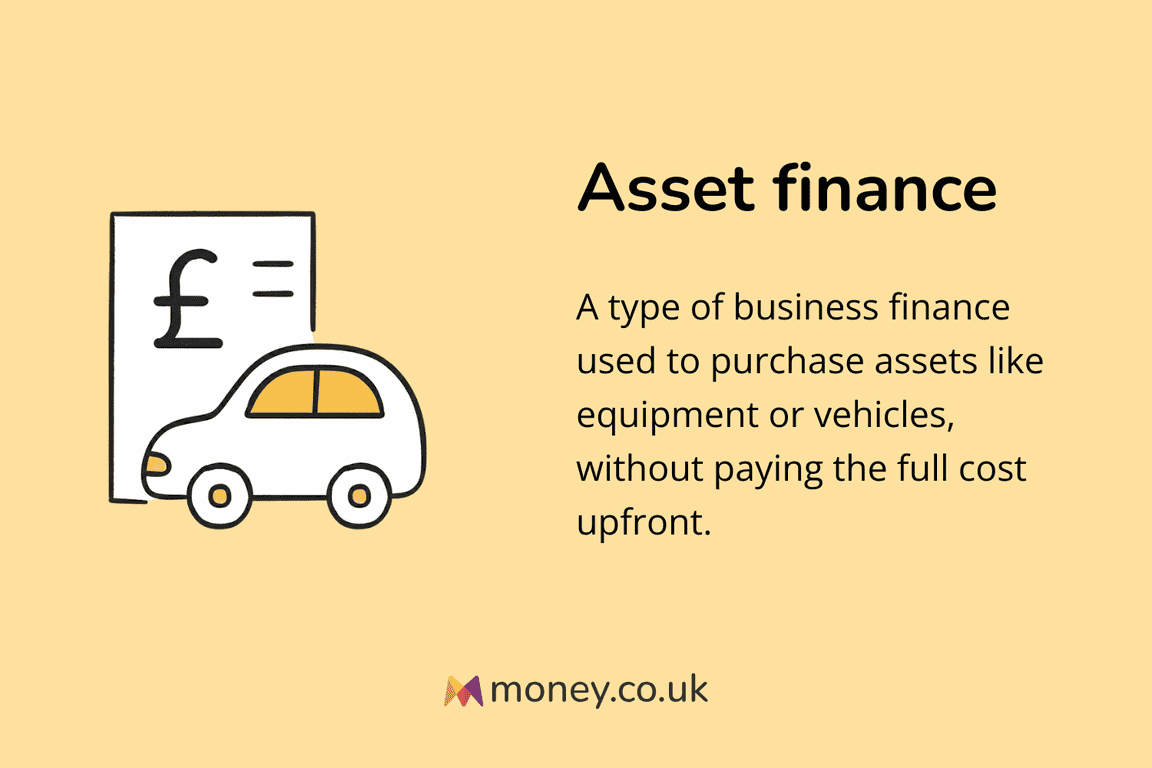
Rather than investing large amounts of capital upfront to pay for this equipment outright, asset finance enables a business to spread the cost over time - making smaller, regular payments over the term of their agreement.
Thanks to this flexibility, it can be easier to replace old and tired equipment or buy additional equipment to help expand your business and increase the volume of products you offer or sell without compromising your cash flow.
How does asset finance work?
Depending on the type of asset finance you use, you may need to put down an initial deposit for the asset you wish to acquire and then borrow the remaining sum. You repay this amount, plus interest or fees, in monthly instalments.
Your asset acts as security in this type of finance agreement.
At the end of the agreement, you might own the asset outright, purchase it, return it or choose to renew the agreement.
What are the different types of asset finance?
There are several different types of asset finance, as outlined below:
Hire purchase
Hire purchase is one of the most common forms of asset finance. Here, a lender buys the asset, and you lease it from them, making regular payments over a pre-agreed term. The asset appears positively on your balance sheet from the start of the agreement, but the lender retains ownership until you’ve completed your payments.
Once you’ve covered the cost of the asset and the interest, you pay a purchase fee (or balloon payment) to own the asset outright.
Note that you remain responsible for maintaining the asset throughout the lease term and you cannot sell the asset until either the term ends or you settle the contract early.
Finance lease
Again, with finance lease, a finance provider purchases the asset on your behalf and leases it back to your business. You make monthly payments throughout the lease term, which include the initial asset cost and interest.
It’s your responsibility to maintain and insure the asset during the lease term. Once the term ends, you can choose to continue renting the asset, return the asset to the provider, or sell it to a third party on behalf of the finance provider.
Operating lease
An operating lease enables your business to acquire equipment for a limited period. You rent the asset during that time, making regular payments.
One of the biggest benefits of an operating lease is you may have the opportunity to upgrade to a newer model during your rental period. It remains your business' responsibility to maintain the asset throughout the agreement.
Contract hire
Contract hire is generally used to lease cars and vans. It can be particularly beneficial for businesses that require vehicle fleets. That’s because the provider handles the sourcing and maintenance of the vehicles, saving your business time and streamlining the process.
You make payments over a set lease term and at the end of the rental period, you can choose to extend the term or return the vehicles.
Asset refinance
Asset refinance can help you release funds back into your business. A lender evaluates the equity in asset(s) you already own out-right, provides a cash injection based on that value, and wraps it into a new lease agreement so your day-to-day operations face zero disruption.
What are the advantages of asset finance?
There are many benefits to using asset finance. These include:
No large initial outlay: Asset finance can help you access the equipment you need without investing large sums upfront
Manageable payments: You can spread the cost through monthly payments over an agreed period and maintain a steady cash flow
You may be able to upgrade: Some agreements allow you to upgrade your equipment regularly
Save on maintenance costs: With some forms of asset finance, it’s the lender’s responsibility to cover maintenance costs
Helps you keep cash in the bank: You don’t need to tie up cash reserves in your assets, leaving you more for everyday business spending
Can be more accessible: If you have poor credit, you may find it easier to get asset finance than a traditional business loan
What are the disadvantages of asset finance?
As with any type of finance, there are drawbacks to consider too:
Often more expensive: Asset finance is more expensive than buying an asset outright
Assets are used as security: This means if you fail to meet your repayments, the lender could repossess the assets
Limits on use of equipment: In some cases, the lender might restrict the use of the asset, such as placing an annual mileage limit on a lease vehicle. If you ignore this, you could face penalties
Damage liability: Depending on the type of asset finance, you may be liable for any damage to the asset that falls outside the scope of your agreement
Long-term commitment: Most asset finance agreements are at least a year in length
You may never own the asset: Depending on your agreement, your business may never actually own the asset
Is my business eligible for asset finance?
Sole traders, partnerships and limited companies can all apply for asset finance, but you will need to prove to lenders you can afford to meet the monthly repayments on time to be successful.
Additionally, you must run a UK-based business, and some lenders may ask that you have been trading for a set amount of time. You will typically need to show your bank statements for the past year.
Once the lender approves your application, it funds the purchase and your business gains access to the asset.
💡 Editor insight: Cash flow is taking a toll on SME leaders’ focus and decision-making
Is asset finance right for your business?
If you’re looking to expand your business and need access to the latest equipment and technology but don’t have the capital to buy it outright, asset finance is certainly worth considering. It can be particularly beneficial if your business is new or if your business experiences fluctuations in cash flow.
However, it’s crucial to shop around and compare your options carefully to ensure you can comfortably afford the repayments. You should also consider whether you want to own the asset at the end of the agreement, whether you’re happy to pay a deposit and how long you want to finance the asset for.
Other financing options you might want to consider include:
FAQs
You can finance a range of assets, including vehicles, plant equipment, machinery, IT equipment and production tools. You could also use asset finance to help you invest in solar panels, new heating systems and so on.
Asset finance enables you to borrow money to acquire assets for your business, while asset-based lending uses assets you already own as security against a loan. The amount you can borrow with asset-based lending depends on the value of the assets used as security.
The amount you can borrow with asset finance depends on factors such as the strength of your business and its creditworthiness, the type of asset finance you choose, and the value of the assets. Lenders also look at your business’s ability to meet monthly repayments before deciding how much to let you borrow.
Yes, you may be able to apply for asset finance with bad credit. However, this depends on the type of asset finance you’re looking for and the lender’s confidence in your ability to repay. Due to the higher risk you pose to lenders, you may have to pay higher interest rates, or your agreement may have stricter terms.
In some cases, the lender might ask you to pay a larger deposit, secure the finance against valuable assets, or prove that you have strong cash flow and business performance.
One of the key differences between asset finance and traditional bank loans is that asset finance can be easier to qualify for as the asset acts as security for the loan. Your business’s creditworthiness plays a bigger role when applying for an unsecured bank loan.
In addition, asset finance can help businesses spread the cost of a business asset, such as machinery, but you won’t own the asset until you’ve completed your repayments.
By contrast, with a bank loan, you receive a lump sum of cash that you can then use for whatever you need. For example, you might use your loan to buy equipment outright, or you might use it to pay for staff salaries, inventory or essential repairs to your business property.
Yes, it’s possible to get asset finance if you’re a startup business. In fact, it can be particularly beneficial for startups that are unlikely to have the cash to pay for essential vehicles and equipment upfront. It also frees up cash to use elsewhere in your company.
No, you can’t generally sell the asset during the term of your finance agreement unless your contract expressly permits it. You must usually pay off the loan in full before selling the asset. This is because the finance provider retains ownership until then.
Yes, asset finance is a regulated product in the UK, although it’s not as strictly regulated as other types of business loans. You should always check that the Financial Conduct Authority (FCA) regulates your chosen lender. Using an FCA-regulated lender ensures you have sufficient protection and are offered suitable products.
More business loan guides and insights
- How do business loans work? Here’s what you need to know
- The average business loan interest rates for 2026
- Am I eligible for a business loan? Key criteria and how to qualify
- How to get a business loan: your step-by-step guide to approval
- Is your business ‘loan ready’? How lenders really assess SMEs
- How to access emergency business funding
- 50+ UK business loan statistics
- Business loans | Compare funding from £500 to £15,000,000
About Rachel Wait
Rachel has spent the majority of her career writing about personal finance for leading price comparison sites and the national press, including for the Mail on Sunday, The Observer, The Spectator, the Evening Standard, Forbes UK and The Sun.
View Rachel Wait's full biography here or learn more about our editorial policy